الآثار الإشعاعية الناجمة عن حادثة فوكوشيما النووية
المحتويات
- JAIF (5 November 2011) Earthquake-report 256
- اليود-131
- الآثار النفسية لإدراك التعرض للإشعاع
- الانبعاثات المائية
- خارطة الإشعاع في اليابان
- Nattō
- Rush for iodine
- Japanese government nuclear adviser quits
- JAIF (21 January 2012)Earthquake report 324
- وكالة السلامة النووية والصناعية، المنظمة السابقة
- Disposal of radioactive ash
- Strontium وكالة حماية البيئة الأمريكية
- http://www.phyast.pitt.edu/~blc/book/chapter5.html
- Computer simulations of caesium contamination
- Plankton
- القلق
- السيزيوم-137
- Distribution by sea
- Air exposure within 30 kilometers
- الانتحار
- Air and direct radiation
- Regulatory levels
- JIAF (15 November 2011) Earthquake-report 265
- Tea-leaves
- U.S. military
- Wildlife
- فوكوشيما 50
- JAIF (11 November 2011) Earthquake-report 262
- Isotopes of concern
- Breast milk
- Mushrooms
- Building materials
- JAIF (24 January 2012)Earth-quake report 327
- Radiation exposure in the city of Fukushima
- Noodles
- Distribution outside Japan
- Exposure of workers
- نظائر البلوتونيوم
- Air exposure outside of 30 kilometers
- Summarised daily events
- Soil
- Iodine-intake
- السترونتيوم-90
- JAIF (29 November 2011) Earthquake report 276
- Discharge to seawater and contaminated sealife
- Ground and water contamination within 30 kilometers
- الانبعاثات الجوية
- Children
- الاكتئاب
- التيلوريوم-129م
- Drinking water
- Radiation outside primary containment of the reactors
- Cattle and beef
- Decontamination efforts
- Agricultural products
- اضطراب ما بعد الصدمة
- Radioactive dust particles
- p. 49, no. 6 of
- الآثار الصحية
- إجمالي الانبعاثات
- Radiation and nuclide detection in Japan
- Soil
- Reuters
- Caesium-134 and caesium-137 soil contamination map
- Rice
- New radioactivity limits for food in Japan
- Distribution by air
- Jaif (22 July 2011)Earthquake Report 150
- Elementary school yard in Tokyo
- Baby-milk
- Hot spots at school-yards
- Radiation at the plant site
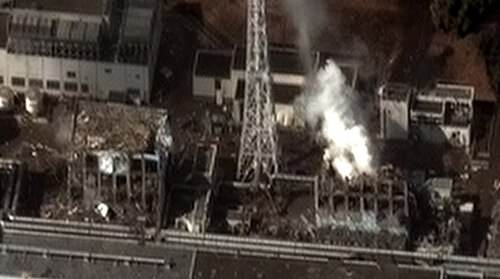
تعريفًا بالموضوع، تتمثل الآثار الإشعاعية الناجمة عن كارثة فوكوشيما النووية في التأثيرات المرصودة والمتوقعة نتيجة انبعاث النظائر المشعة من محطة فوكوشيما دايتشي للطاقة النووية في أعقاب زلزال وتسونامي توهوكو 2011. وقد نتج تسرب النظائر المشعة من أوعية احتواء المفاعلات عن عمليات التنفيس التي أُجريت لتقليل ضغط الغازات، فضلًا عن تصريف مياه التبريد في البحر. وقد دفع ذلك السلطات اليابانية إلى فرض منطقة عزل بطول 30 كم حول محطة الطاقة، مما تسبب في استمرار نزوح ما يقرب من 156,000 شخص حتى أوائل عام 2013. وانخفض عدد النازحين إلى 49,492 شخصاً بحلول مارس 2018. ومنذ ذلك الحين، رُصدت جزيئات مشعة ناتجة عن الحادث، بما في ذلك نظير اليود 131 والسيزيوم-134 و137، في محطات أخذ عينات النويدات المشعة في الغلاف الجوي حول العالم، بما في ذلك كاليفورنيا والمحيط الهادئ. وفيما يلي تفاصيل أوسع عن ذلك.
من جهة ثانية، تشير تقارير تقدير الجرعات الأولية الصادرة عن منظمة الصحة العالمية ولجنة الأمم المتحدة العلمية المعنية بآثار الإشعاع الذري إلى أن المخاطر المتوقعة تظل منخفضة خارج المناطق الجغرافية الأكثر تضرراً بالإشعاع، وحتى في مواقع داخل محافظة فوكوشيما، ولا يُتوقع حدوث أي زيادات ملحوظة في معدلات السرطان تتجاوز التباين الطبيعي في المعدلات الأساسية. وبالمقارنة، فبعد حادثة مفاعل تشيرنوبل، لم يُصب سوى 0.1% من بين 110,000 من عمال التنظيف الذين شملهم الاستطلاع بسرطان الدم حتى الآن، رغم أن جميع الحالات لم تكن ناجمة عن الحادث. ومع ذلك، تلقى 167 عاملاً في محطة فوكوشيما جرعات إشعاعية تزيد بشكل طفيف من خطر إصابتهم بالسرطان. وتُعد الجرعات الفعالة المقدرة من الحادث خارج اليابان أقل بكثير من مستويات الجرعات التي يعتبرها المجتمع الدولي للحماية من الإشعاع ضئيلة للغاية. ومن المتوقع أن تصدر لجنة الأمم المتحدة العلمية المعنية بآثار الإشعاع الذري تقريراً نهائياً عن آثار التعرض للإشعاع الناجم عن الحادث بحلول نهاية عام 2013.
وفي هذا السياق، قدرت دراسة أجرتها جامعة ستانفورد في يونيو 2012، باستخدام نموذج اللاعتبة الخطي، أن إطلاق النشاط الإشعاعي من محطة فوكوشيما دايتشي النووية قد يتسبب في 130 حالة وفاة بسبب السرطان على مستوى العالم (الحد الأدنى للتقدير 15 والحد الأقصى 1100) و199 حالة إصابة بالسرطان في المجمل (الحد الأدنى 24 والحد الأقصى 1800)، ويُقدر أن أغلبها سيحدث في اليابان. كما توقعت الدراسة أن يؤدي التعرض للإشعاع بين العاملين في المحطة إلى وفاة ما بين شخصين و12 شخصاً. ومع ذلك، أفاد بيان صادر عن لجنة الأمم المتحدة العلمية المعنية بآثار الإشعاع الذري في ديسمبر 2012 أمام مؤتمر فوكوشيما الوزاري حول السلامة النووية أنه "بسبب عدم اليقين الكبير في تقديرات المخاطر عند الجرعات المنخفضة جداً، فإن اللجنة لا توصي بضرب الجرعات المنخفضة جداً في أعداد كبيرة من الأفراد لتقدير عدد الآثار الصحية الناجمة عن الإشعاع بين السكان المعرضين لجرعات تزايدية بمستويات تعادل أو تقل عن مستويات الخلفية الطبيعية".
JAIF (5 November 2011) Earthquake-report 256
ومن ناحية أخرى، JAIF (15 October 2011)Earthquake-report 235: Radioactive cesium found in plankton off the nuclear plant
إضافةً إلى ذلك، JAIF (12 September 2011) Earthquake report 202: Radiation checks on wild plants, animals urged
JAIF (20 January 2012)Earthquake report 323
اليود-131
من جانب آخر، وفي 12 أبريل 2011، قَدَّرت وكالة السلامة النووية والصناعية ولجنة السلامة النووية إجمالي الانبعاثات الجوية لـ اليود-131 بنحو 130 و150 بيتا بيكريل على التوالي (أي قرابة 30 جراماً). ومع ذلك، في 23 أبريل، عدلت لجنة السلامة النووية تقديراتها الأصلية، مشيرةً إلى انبعاث قدره 0.14 تيرا بيكريل في الساعة في 5 أبريل.
من جانب آخر، وفي سبتمبر 2011، أظهر مسح أجرته وزارة العلوم اليابانية أن اليود المشع انتشر في اتجاه الشمال الغربي والجنوب من المحطة. وبسبب قصر عمر النصف لليود (8 أيام)، لم تظهر النتائج إيجابية إلا في 400 موقع فقط من أصل 2,200 موقع أُخذت منها عينات التربة في يونيو ويوليو. وأظهرت الخريطة انتشار اليود-131 شمال غرب المحطة، تماماً كالسيزيوم-137، كما عُثر عليه بمستويات عالية نسبياً في المناطق الساحلية جنوب المحطة؛ حيث يبدو أن السحب المتجهة جنوباً حملت كميات كبيرة من اليود المنبعث حينها. وقد أُجري هذا المسح لتحديد مخاطر الإصابة بـ سرطان الغدة الدرقية بين السكان.
ومن جهة أخرى، قَدَّر تقرير صادر عن المعهد المركزي للأرصاد الجوية والديناميكا الجيوديناميكية في النمسا إجمالي اليود-131 المنبعث في الهواء حتى 19 مارس بنحو 10 إلى 700 بيتا بيكريل، وذلك بناءً على استقراء البيانات من عدة أيام من المراقبة في محطات قياس النيوكليدات المشعة التابعة لـ منظمة معاهدة الحظر الشامل للتجارب النووية في ألمانيا والسويد واليابان والولايات المتحدة. وتمثل هذه التقديرات ما بين 1% إلى 40% من كمية اليود-131 التي قُدِّر انبعاثها في تشيرنوبل والبالغة 1760 بيتا بيكريل.
الآثار النفسية لإدراك التعرض للإشعاع
في هذا الإطار، وقد أُطلق مسح إدارة الصحة في فوكوشيما (FHMS) لمراقبة صحة السكان على المدى الطويل وتعزيز رفاهيتهم. ويشمل هذا المسح أربعة فحوصات تفصيلية: فحص الغدة الدرقية، وفحصاً صحياً شاملاً، ومسح الصحة العقلية ونمط الحياة، ومسح الحمل والولادة. وبحسب نتائج المسح، فإن أكثر ثلاثة تشخيصات نفسية شيوعاً هي: الاكتئاب، والقلق، واضطراب ما بعد الصدمة.
وفي هذا السياق، استُخدمت نتائج أبحاث كارثة تشيرنوبل في الاستجابة لكارثة فوكوشيما. وأظهر مسح أجرته الحكومة المحلية في "إيتات" بفوكوشيما أن الكثير من السكان يعانون من إحباط وعدم استقرار متزايدين بسبب الأزمة النووية وعدم قدرتهم على العودة لحياتهم السابقة. وأفاد 60% من المستجيبين بتدهور صحتهم وصحة عائلاتهم بعد الإجلاء، بينما أبلغ 39.9% عن شعورهم بتهيج عصبي أكبر.
علاوةً على ذلك، أشارت إحصائية لصحيفة "ماينيتشي شيمبون" إلى وقوع 1,600 حالة وفاة مرتبطة بعمليات الإجلاء، وهو رقم يضاهي 1,599 حالة وفاة تسبب بها الزلزال وتسونامي في محافظة فوكوشيما مباشرة.
وفي هذا الصدد، > وبالنظر لجميع الإجابات المتعلقة بالوضع العائلي الحالي للنازحين، تبين أن ثلث العائلات تعيش بعيداً عن أطفالها، بينما يعيش 50.1% بعيداً عن أفراد عائلاتهم الآخرين (بما في ذلك الآباء المسنين) الذين كانوا يعيشون معهم قبل الكارثة. كما أظهر المسح أن 34.7% من النازحين عانوا من تخفيضات في الرواتب بنسبة 50% أو أكثر، وأبلغ 36.8% عن نقص في النوم، بينما أبلغ 17.9% عن زيادة في التدخين أو شرب الكحول.
علاوةً على ذلك، وتشمل عوامل الخطر لهذه النتائج النفسية السلبية: طول مدة الإجلاء، وتضرر المنازل، والانفصال عن العائلة، والبطالة، وفقدان الثقة في الحكومة والسلطات الصحية وإدارة شركة طوكيو للطاقة الكهربائية (تيبكو) ، والوصمة المستمرة المتعلقة بالإشعاع. وترتبط الصحة العقلية المتدهورة بالوفاة المبكرة والعجز. وتعتبر الفئات الأكثر عرضة للخطر هي عمال المحطة، والأمهات المرضعات، والأطفال، والرجال العاطلون عن العمل في منتصف العمر.
إضافةً إلى ذلك، ويتفق الخبراء في اليابان على أن تحديات الصحة العقلية هي القضية الأبرز؛ فالإجهاد الناتج عن النزوح وعدم اليقين والقلق من الملوثات غير المرئية يتجلى غالباً في أمراض جسدية مثل أمراض القلب. ويواجه سكان المناطق المتضررة خطراً متزايداً للإصابة بـ الاكتئاب، والقلق، واضطراب ما بعد الصدمة (PTSD)، والأعراض الجسدية غير المفسرة طبياً، والانتحار.
إضافةً إلى ذلك، وفي الاتحاد السوفيتي السابق، ظهر لدى الكثير من المرضى الذين تعرضوا لقدر ضئيل من الإشعاع بعد كارثة تشيرنوبل قلق شديد، مما أدى لتطور مشكلات نفسية جسدية، بما في ذلك الخوف من الإشعاع، مع ملاحظة زيادة في النزعة القدرية وإدمان الكحول. وكما ذكر خبير الصحة والإشعاع الياباني "شونيتشي ياماشيتا":
الانبعاثات المائية
في هذا الإطار، وبحسب تقرير فرنسي صدر في أكتوبر 2011، دخل المحيط نحو 8.4 كجم من السيزيوم-137 في الفترة ما بين مارس ويوليو 2011. ويُمثل هذا أكبر انبعاث فردي للنشاط الإشعاعي الاصطناعي في البحر يُرصد على الإطلاق. ونظراً لأن ساحل فوكوشيما يتمتع ببعض أقوى التيارات البحرية في العالم، فقد نُقلت المياه الملوثة بعيداً في المحيط الهادئ مما ساعد على تشتيتها. ورغم أن تركيز السيزيوم في المياه ظل أعلى بـ 10 إلى 1000 مرة من مستويات ما قبل الحادث، إلا أن المخاطر الإشعاعية تُعد دون المستويات الضارة بالحيوانات البحرية أو المستهلكين من البشر.
إضافةً إلى ذلك، ومع ذلك، أظهرت القياسات في سنة 2012 أن الأسماك التي صُيدت قرب المحطة لا تزال تحتوي على مستويات عالية من السيزيوم المشع؛ ففي أغسطس 2012، اصطيدت سمكتان تحتويان على أكثر من 25 كيلو بيكريل/كجم من السيزيوم، وهو ما يتجاوز حد السلامة الحكومي بـ 250 مرة. وفي أغسطس 2013، أفادت لجنة رقابية أن المياه الجوفية الملوثة قد اخترقت حاجزاً تحت الأرض وبدأت تتسرب إلى البحر بعد تجاوز الحدود القانونية للتصريف.
وفي السياق ذاته، كما أُبلغ عن تسرب أو ضخ 300,000 طن أخرى من المياه الأقل تلوثاً في البحر لتوفير مساحة لتخزين المياه شديدة التلوث. وحاولت تيبكو احتواء المياه الملوثة في الميناء القريب بتركيب "ستائر" لمنع التدفق، لكنها تعتقد الآن أن هذه الجهود لم تكن ناجحة.
إضافةً إلى ذلك، بدأ تصريف المياه المشعة لمحطة فوكوشيما دايتشي النووية في أبريل 2011. وقَدَّرت تيبكو أن 520 طناً من المياه المشعة تسربت إلى البحر قبل سد الفجوات في الوحدة الثانية، بإجمالي 4.7 بيتا بيكريل (وهو ما يعادل 20,000 ضعف الحد السنوي المسموح به للمنشأة).
خارطة الإشعاع في اليابان
كذلك، معلومات وزارة الخارجية حول تسرب المياه الملوثة في محطة فوكوشيما دايتشي النووية التابعة لشركة تيبكو ، وزارة الخارجية
ومن ناحية أخرى، معلومات رئاسة الوزراء حول تسرب المياه الملوثة في محطة فوكوشيما دايتشي النووية التابعة لشركة تيبكو، رئيس وزراء اليابان ومجلس وزرائه
هيئة الرقابة النووية اليابانية ، مفوضية الرقابة النووية
البيانات الصحفية لشركة تيبكو ، شركة طوكيو للطاقة الكهربائية
Nattō
إضافةً إلى ذلك، In August 2011, a group of 5 manufacturers of nattō, or fermented soybeans, in ميتو (إيباراكي) planned to seek damages from TEPCO because their sales had fallen by almost 50 percent. Nattō is normally packed in rice-straw and after the discovery of caesium contamination, they had lost a number of customers. The lost sales from April–August 2011 had risen to around 1.3 million dollars.
Rush for iodine
من جهة ثانية، The World Health Organisation said it had received reports of people being admitted to poison centres around the world after taking iodine tablets in response to fears about harmful levels of radiation coming out of the damaged nuclear power plant in Fukushima.
علاوةً على ذلك، Fear of radiation from Japan prompted a global rush for iodine pills, including in the United States, Canada, Russia, Korea, China, Malaysia and Finland. There was a rush for iodized salt in China. A rush for iodine antiseptic solution appeared in Malaysia. WHO warned against consumption of iodine pills without consulting a doctor and also warned against drinking iodine antiseptic solution. The United States Pentagon said troops were receiving يوديد البوتاسيوم before missions to areas where possible radiation exposure is likely.
Japanese government nuclear adviser quits
- (Dutch) Nu.nl (17 July 2011) Radioactive meat found in Japan
- (Dutch) NRC (14 March 2012)Dutch company grows bio/diesel in Fukushima
- The West Japan finds high levels of radiation in fish
علاوةً على ذلك، http://www.yomiuri.co.jp/dy/national/20110424dy04.htm Atmospheric radiation leak underestimated
المصادر
في هذا الإطار، Nu.nl (Dutch) (15 November 2011) Produce of food around Fukushima should probably be limited
وصلات خارجية
JAIF (21 January 2012)Earthquake report 324
علاوةً على ذلك، The Mainichi Shimbun (4 April 2012)Cesium in excess of new gov't limit detected in smelt from Gunma lake
من جانب آخر، http://www.latimes.com/news/nationworld/world/la-fg-japan-workers-20110329,0,319767.story Workers suffer hardships in effort to stabilize Fukushima plant
وفي هذا السياق، The Mainichi Daily News (12 October 2011) Strontium-90 found in the city of Yokohama
وفي هذا السياق، NHK-world (24 January 2012) Radioactive release from Fukushima plant rises
وفي السياق ذاته، Aoki, Mizuho, "Cesium contamination in food appears to be on wane", جابان تايمز, 25 September 2012, p. 3
وفي السياق ذاته، The Mainichi Daily News (12 November 2011) Gov't updates radiation maps with data on six new prefectures
وعلى صعيد آخر، The Mainichi Shimbun (1 April 2012) Foods with excessive radiation under new rule found in 8 prefectures
من جهة ثانية، The Mainichi Daily News (23 January 2012)Radioactive crushed stone used in around 60 Fukushima buildings
إضافةً إلى ذلك، New York Times (19 August 2011) Radiation Discovered in Rice Near Tokyo
كذلك، The Japan Times (23 April 2012)Fukushima air to stay radioactive in 2022
- Illegal levels of radioactive substances found in Fukushima mushrooms
- Several months needed to stop radiation from Fukushima plant: gov't
- Highly radioactive water in nuke plant to be moved for storage.
في هذا الإطار، The Mainichi Daily News (29 November 2011) Farm households in 2 Fukushima cities to suspend rice shipments
في هذا الإطار، The Mainichi Daily News (5 October 2011) High dosage of cesium found in soil outside Fukushima no-go zone
وفي هذا السياق، JAIF (22 January 2012) Earthquake report 325: Contaminated crushed stone found in more houses
علاوةً على ذلك، The Mainichi Daily News (30 October 2011) Excessive cesium detected in greenhouse-grown mushrooms in Fukushima
من جانب آخر، The Mainichi Shimbun (31 March 2012)Fukushima fishermen hopeless after nuke contamination postpones fishing season
في هذا الإطار، NHK-world (1 April 2012)Government tightens control over cesium in food
ومن جهة أخرى، The Mainichi Shimbun (18 June 2012) Japan failed to use U.S. radiation data gathered after nuke crisis
كذلك، Mainichi Japan (21 October 2011)Chiba Pref. city finds major radioactive hot spot on public land
- NHK-world (19 June 2012) Govt to review its withholding of radiation maps
- NHK-world (2 November 2011) Radioactive materials detected in Tokyo Bay
- NHK-world (15 November 2011) Radioactive cesium may have reached Hokkaido
- NHK-world (13 December 2011) Radioactive cesium detected in Tokyo grade school
- NHK-world (17 November 2011) Fukushima Prefecture probes cesium-tainted rice
- NHK-world (25 November 2011) More Fukushima rice tainted with cesium
- NHK-world (29 November 2011) Cesium detected from more Fukushima rice
- NHK-world (11 November 2011) High level of radioactivity in Tochigi mushrooms
- NHK-world (5 November 2011) Radioactivity in Fukushima children's urine
- NHK-world (21 January 2012) Contaminated crushed stone found in more houses
- Plutonium In Fuel Rods: Cause For Concern? By Dan Charles, 17 March 2011, NPR.
ومن ناحية أخرى، The Mainichi Daily News (23 October 2011)High-level radioactive cesium detected in soil in Kashiwa
ومن ناحية أخرى، The Mainichi Daily News (17 November 2011)Japan mulling banning cesium-tainted rice shipments from Fukushima
من جهة ثانية، The Mainichi Daily News (20 January 2012)Radioactive gravel also used in construction of private house in Fukushima
NHK-world (14 October 2011)
وفي هذا السياق، The Mainichi Daily News) (21 January 2012)Radiation of 40 microsieverts per hour detected at Namie quarry
وفي هذا السياق، The Mainichi Shimbun (3 July 2012)High level of radioactive cesium detected in Fukushima freshwater fish
من جهة ثانية، The Mainichi Daily News (16 February 2012)Massive levels of radioactive cesium detected at quarry near Fukushima plant
علاوةً على ذلك، The Mainichi Shimbun (14 April 2012) Japan resumes rice exports to China
وفي هذا السياق، The Mainichi Daily News (1 November 2011) Gov't releases map of radioactive tellurium 129m contamination around nuke plant
من جانب آخر، The Mainichi Daily News (13 January 2012) Fukushima city says radiation dose level unlikely to harm health
وفي هذا الصدد، http://www3.nhk.or.jp/daily/english/24_01.html TEPCO: Highly radioactive concrete fragment found
في هذا الإطار، The Mainichi Shimbun (7 May 2012)'Hot spots' detected at more than 20 schools in Koriyama
Japan-times (17 July 2011) Shipment ban on beef may widen
من جهة ثانية، The Mainichi Shmbun (18 March 2013) Record cesium level detected in fish caught near Fukushima plant
وفي السياق ذاته، The Mainichi Daily News (21 January 2012)Fukushima quarry agents to voluntarily check radiation level
من جهة ثانية، The Mainichi Daily News (2 November 2011) Schoolgirl in Fukushima exposed to high level of radiation in September
وفي هذا السياق، The Mainichi Daily News (20 January 2012) TEPCO urged to compensate for tainted building material in Fukushima
وفي السياق ذاته، Fukushima radioactive fallout nears Chernobyl levels – health – 24 March 2011. New Scientist. Retrieved 30 April 2011.
وفي هذا السياق، The Mainichi Daily News (13 February 2012)High level of radioactive cesium found in Okinawa noodles
وفي هذا الصدد، The Mainichi Shimbun (30 March 2012)Highest level of radioactive cesium to date found in freshwater fish in Fukushima village
إضافةً إلى ذلك، The Mainichi Daily News (5 January 2012) Kashiwa stops operation of incinerator again as radioactive ash fills up storage
في هذا الإطار، Contaminated nuke plant workers going back on job as safety regs go by wayside
من جانب آخر، The Mainichi Shimbun (19 July 2013) 1,973 Fukushima plant workers have higher risk of thyroid cancer
علاوةً على ذلك، https://www.nytimes.com/2011/04/19/world/asia/19japan.html Radiation Levels a Bar to New Plan for Japanese Nuclear Plant
وفي السياق ذاته، http://www3.nhk.or.jp/daily/english/04_10.html Govt did not reveal high level radiation estimate
ومن ناحية أخرى، Scientists Project Path of Radiation Plume By William J. Broad, 16 March 2011, نيويورك تايمز
وعلى صعيد آخر، The Mainichi Daily news( 26 October 2011) High levels of radiation detected at 2 schools in Chiba Prefecture
من جانب آخر، The Mainichi Daily News( 25 October 2011) Nuclear plant accidents threaten relations between food producers and consumers
وعلى صعيد آخر، The Mainichi Daily News (10 December 2011) Meiji ignored info on cesium-tainted baby food for 2 weeks
كذلك، Mainichi Japan (20 October 2011) Most detailed radiation map published by the Japanese government
وعلى صعيد آخر، https://www.wsj.com/articles/SB10001424052748704471904576229854179642220 At Plant, a Choice Between Bad, Worse
وكالة السلامة النووية والصناعية، المنظمة السابقة
من جهة ثانية، الملاحة في فوكوشيما: دروس من تشيرنوبل، والآثار الإشعاعية المحتملة، والتأثيرات الصحية الأخرى ، سؤال وجواب مع الدكتور سكوت ديفيس حول آليات الأزمة في فوكوشيما ومقارنتها بتشيرنوبل
قياسات مفصلة لمستويات الإشعاع في الهواء في فوكوشيما 1
وفي هذا السياق، تحديثات الوكالة الدولية للطاقة الذرية حول زلزال اليابان ، الوكالة الدولية للطاقة الذرية
Disposal of radioactive ash
ومن ناحية أخرى، Radiation monitoring in all 47 prefectures showed wide variation, but an upward trend in 10 of them on 23 March. No deposition could be determined in 28 of them until 25 March The highest value obtained was in Ibaraki (480 Bq/m2 on 25 March) and Yamagata (750 Bq/m2 on 26 March) for iodine-13. For caesium-137, the highest values were in Yamagata at 150 and 1200 Bq/m2 respectively.
من جهة ثانية، On 5 January 2012 the Nambu (south) Clean Center, a waste incinerator in Kashiwa, Chiba, was taken out of production by the city council because the storage room was completely filled with 200 metric tons of radioactive ash that could not disposed of in landfills. Storage at the plant was full, with 1049 drums, and some 30 tons more were still to be taken out of the incinerator. In September 2011, the factory was closed for two months for the same reason. The center's special advanced procedures were able to minimize the volume of the ash, but radioactive caesium was concentrated to levels above the national limit of 8.000 becquerels per kilogram for waste disposal in landfills. It was not possible to secure new storage space for the radioactive ash. Radiation levels in Kashiwa were higher than in surrounding areas, and ashes containing up to 70,800 becquerels of radioactive caesium per kilogram – higher than the national limit – were detected in the city. Other cities around Kashiwa were facing the same problem: radioactive ash was piling up. Chiba prefecture asked Abiko and Inzai to accept temporary storage at the Teganuma waste-disposal facility located at their border. But this met strong opposition from their citizens.
كذلك، Summary of restrictions imposed by the Japanese government as of 25 April 2011
كذلك، Due to objections from concerned residents it became more and more difficult to dispose of the ashes of burned household garbage in and around Tokyo. The ashes of waste facilities in the Tohoku، Kanto and منطقة كوشينيتسوs were proven to be contaminated with radioactive caesium. According to the guidelines of the Ministry of Environment, ashes radiating 8,000 becquerels per kilogram or lower could be buried. Ashes with caesium levels between 8,000 and 100,000 becquerels should be secured, and buried in concrete vessels. A survey was done on 410 sites of waste-disposal facilities, on how the ash disposal was proceeding. At 22 sites, mainly in the Tokyo Metropolitan area, the ashes with levels under 8000 becquerels could not be buried due to the objections of concerned residents. At 42 sites, ashes were found that contained over 8,000 becquerels of caesium, which could not be buried. The ministry made plans to send officials to meetings in the municipalities to explain to the Japanese people that the waste disposal was done safely, and to demonstrate how the disposal of the ashes above 8000 becquerels was conducted.
كذلك، Deposition of radioactivity and effect on agricultural products and building materials
ومن جهة أخرى، Measurements made in Japan in a number of locations have shown the presence of radionuclides in the ground. On 19 March, upland soil levels of 8,100 Bq/kg of Cs-137 and 300,000 Bq/kg of I-131 were reported. One day later, the measured levels were 163,000 Bq/kg of Cs-137 and 1,170,000 Bq/kg of I-131.
Strontium وكالة حماية البيئة الأمريكية
وفي هذا الصدد، Japan Plant Fuel Melted Partway Through Reactors: Report, Friday, 15 April 2011
وعلى صعيد آخر، Jaif (28 August 2011) Kan: Central storage plant planned in Fukushima
ومن جهة أخرى، JAIF (8 April 2012)Earthquake-report 397: Radioactive cesium found in farm goods near Tokyo
من جانب آخر، Jaif (3 August 2011) Fukushima to begin beef cattle buy-up second week of August
إضافةً إلى ذلك، JAIF (20 September 2011) Earthquake-report 211: A new plan set to reduce radiation emissions
ومن ناحية أخرى، JAIF (5 September 2011) NSC Recalculates Total Amount of Radioactive Materials Released
http://www.phyast.pitt.edu/~blc/book/chapter5.html
في هذا الإطار، http://www3.nhk.or.jp/daily/english/27_10.html Science ministry releases Fukushima radiation map
وفي هذا الصدد، http://www.asahi.com/english/TKY201105120189.html TEPCO drowning in dealing with tons of radioactive water
Computer simulations of caesium contamination
علاوةً على ذلك، The first study concentrated on caesium-137. Around the nuclear plant, places were found containing up to 40.000 becquerels/kg, 8 times the governmental safety limit of 5.000 becquerels/kg. Places further away were just below this maximum. East and north-east from the plant the soil was contaminated the most. North-west and westwards the soil was less contaminated, because of mountain protection.
في هذا الإطار، Based on radiation measurements made all over Japan between 20 March and 20 April 2011, and the atmospheric patterns in that period, computer simulations were performed by an international team of researchers, in cooperation with the University of Nagoya, in order to estimate the spread of radioactive materials like caesium-137. Their results, published in two studies on 14 November 2011, suggested that caesium-137 reached up to the northernmost island of هوكايدو, and the regions of Chugoku and شيكوكو in western Japan at more than 500 kilometers from the Fukushima plant. Rain accumulated the caesium in the soil. Measured radioactivity per kilogram reached 250 becquerels in eastern Hokkaido, and 25 becquerels in the mountains of western Japan. According to the research group, these levels were not high enough to require decontamination. Professor Tetsuzo Yasunari of the University of Nagoya called for a national soil testing program because of the nationwide spread of radioactive material, and suggested identified hotspots, places with high radiation levels, should be marked with warning signs.
ومن جهة أخرى، The second study had a wider scope, and was meant to study the geographic spread of more-radioactive isotopes, like tellurium and iodine. Because these isotopes deposit themselves in the soil with rain, Norikazu Kinoshita and his colleagues observed the effect of two specific rain-showers on 15 and 21 March 2011. The rainfall on 15 March contaminated the grounds around the plant; the second shower transported the radioactivity much further from the plant, in the direction of Tokyo. According to the authors, the soil should be decontaminated, but when this is found impossible, farming should be limited.
Plankton
وعلى صعيد آخر، Radioactive caesium was found in high concentration in plankton in the sea near the Fukushima Daiichi Nuclear Power Plant. Samples were taken up to 60 kilometers from the coast of Iwaki city in July 2011 by scientists of the جامعة طوكيو للعلوم البحرية والتكنولوجيا. Up to 669 becquerels per kilogram of radioactive caesium was measured in samples of animal plankton taken 3 kilometers offshore. The leader of the research-group Professor Takashi Ishimaru, said that the sea current continuously carried contaminated water southwards from the plant. Further studies to determine the effect on the food-chain and fish would be needed.
القلق
من جهة ثانية، واتُّخذت تدابير لتقليل التعرض للإشعاع، منها فرض قيود صارمة على بعض الأغذية المحلية والدولية، وظلت هذه القيود سارية لأن الجمهور لم يكن لديه تصور واضح عن مخاطر الإشعاع. كما واجه رفع قيود الإقامة في مناطق الإجلاء صعوبات، حيث كان السكان قلقين من العودة بسبب المخاوف الصحية وعدم استقرار المجتمعات. ومع أن الجرعات المنخفضة قد لا تسبب أمراضاً لأغلب الأفراد، إلا أن الأمر يثير تساؤلات أخلاقية حول كيفية التعامل مع الإجلاء وتأثيره النفسي مقابل تكلفة التعرض لنسب ضئيلة من الإشعاع.
في هذا الإطار، يُعد الخوف من التعرض للإشعاع من أكثر المخاوف شيوعاً في الحوادث النووية، وكان قلق الآباء أحد أسباب إجراء فحوصات الغدة الدرقية للأطفال. وفي عام 2015، وجدت دراسة أن نحو نصف عينة من 300,473 طفلاً خضعوا للفحص ظهرت لديهم عقيدات أو أكياس.
السيزيوم-137
وفي السياق ذاته، في مارس 2011، قَدَّر تقرير نمساوي أن متوسط انبعاث السيزيوم-137 يبلغ 5 بيتا بيكريل يومياً بناءً على بيانات محطات الرصد العالمية. وللمقارنة، أطلقت كارثة تشيرنوبل إجمالاً 85 بيتا بيكريل من السيزيوم-137. ولاحقاً في أبريل، قدرت وكالة السلامة النووية واللجنة الأمنية إجمالي الانبعاثات بنحو 6.1 إلى 12 بيتا بيكريل (قرابة 2-4 كجم).
Distribution by sea
كذلك، The survey by the Japan Agency for Marine-Earth Science and Technology (JAMSTEC) reveals that radioactive caesium released from Fukushima I Nuclear Power Plant reached the ocean 2000 kilometers from the plant and 5000 meters deep one month after the accident. It is considered that airborne caesium particles fell on the ocean surface, and sank as they were attached to the bodies of dead plankton. The survey result was announced in a symposium held on 20 November in Tokyo. From 18 to 30 April, JAMSTEC collected "marine snow", sub-millimeter particles made mostly of dead plankton and sand, off the coast of Kamchatka Peninsula, 2000 kilometers away from Fukushima, and off the coast of Ogasawara Islands, 1000 kilometers away, at 5000 meters below the ocean surface. The Agency detected radioactive caesium in both locations, and from the ratio of caesium-137 and caesium-134 and other observations it was determined that it was from Fukushima I Nuclear Power Plant. The density of radioactive caesium is still being analyzed, according to the Agency. It has been thus confirmed that radioactive materials in the ocean are moving and spreading not just by ocean currents but by various other means.
كذلك، Seawater containing measurable levels of iodine-131 and caesium-137 were collected by Japan Agency for Marine-Earth Science and Technology (JAMSTEC) on 22–23 March at several points 30 km from the coastline iodine concentrations were "at or above Japanese regulatory limits" while caesium was "well below those limits" according to an IAEA report on 24 March. On 25 March, IAEA indicated that in the long term, caesium-137 (with a half-life of 30 years) would be the most relevant isotope as far as doses was concerned and indicated the possibility "to follow this nuclide over long distances for several years." The organization also said it could take months or years for the isotope to reach "other shores of the Pacific".
Air exposure within 30 kilometers
في هذا الإطار، The zone within 20 km from the plant was evacuated on 12 March, while residents within a distance of up to 30 km were advised to stay indoors. IAEA reported on 14 March that about 150 people in the vicinity of the plant "received monitoring for radiation levels"; 23 of these people were also decontaminated. From 25 March, nearby residents were encouraged to participate in voluntary evacuation.
وفي السياق ذاته، Most detailed radiation map published by the Japanese government
ومن جهة أخرى، A detailed map was published by the Ministry of Education, Culture, Sports, Science and Technology, going online on 18 October 2011. The map contains the caesium concentrations and radiation levels caused by the airborne radioactivity from the Fukushima nuclear reactor. This website contains both web-based and PDF versions of the maps, providing information by municipality as had been the case previously, but also measurements by district. The maps were intended to help the residents who had called for better information on contamination levels between areas of the same municipalities, using soil and air sample data already released. A grid is laid over a map of most of eastern Japan. Selecting a square in the grid zooms in on that area, at which point users can choose more detailed maps displaying airborne contamination levels, caesium-134 or -137 levels, or total caesium levels. Radiation maps
كذلك، In August 2012, Japanese academic researchers announced that 10,000 people living near the plant in Minamisoma City at the time of the accident had been exposed to well less than 1 millisievert of radiation. The researchers stated that the health dangers from such exposure was "negligible". Said participating researcher Masaharu Tsubokura, "Exposure levels were much lower than those reported in studies even several years after the Chernobyl incident."
علاوةً على ذلك، At a distance of from the site, radiation of 3–170 μSv/h was measured to the north-west on 17 March, while it was 1–5 μSv/h in other directions. Experts said exposure to this amount of radiation for 6 to 7 hours would result in absorption of the maximum level considered safe for one year. On 16 March Japan's ministry of science measured radiation levels of up to 330 μSv/h 20 kilometers northwest of the power plant. At some locations around 30 km from the Fukushima plant, the dose rates rose significantly in 24 hours on 16–17 March: in one location from 80 to 170 μSv/h and in another from 26 to 95 μSv/h. The levels varied according to the direction from the plant. In most locations, the levels remained well below the levels required to damage human health, as the recommended annual maximum limit is well below the level that would affect human health.
ومن ناحية أخرى، Natural exposure varies from place to place but delivers a dose equivalent in the vicinity of 2.4 mSv/year, or about 0.3 μSv/h. For comparison, one chest x-ray is about 0.2 mSv and an abdominal CT scan is supposed to be less than 10 mSv (but it has been reported that some abdominal CT scans can deliver as much as 90 mSv). People can mitigate their exposure to radiation through a variety of protection techniques.
ومن ناحية أخرى، On 22 April 2011 a Japanese government report was presented by Minister of Trade Yukio Edano to leaders of the town Futaba. In it predictions were made about radioactivity releases for the years 2012 up to 2132. According to this report, in several parts of Fukushima Prefecture – including Futaba and Okuma – the air would remain dangerously radioactive at levels above 50 millisieverts a year. This was all based on measurements done in November 2011.
الانتحار
في هذا الإطار، من أخطر الآثار طويلة الأمد التي رصدها المسح زيادة معدلات الانتحار. فرغم انخفاض المعدلات في السنوات الأولى، شهد عام 2013 زيادة ملحوظة تجاوزت معدلات ما قبل الكارثة، وكانت الزيادة في فوكوشيما أسرع منها في المحافظات المجاورة المتضررة من الزلزال. ويُعتقد أن خدمات الدعم ساعدت في خفض المعدلات بدايةً، وأن الانتكاسة في 2014 تشير إلى الحاجة المستمرة لهذه الموارد.
علاوةً على ذلك، وحدد الباحثون عوائق تحول دون تحسين نتائج الصحة العقلية، منها: التأخر في صرف التعويضات، و"الاحتراق الوظيفي" للمهنيين الصحيين، والوصمة الاجتماعية المحيطة بالاضطرابات النفسية في الثقافة اليابانية، وعدم الثقة في السلطات. ويوصي الباحثون بضرورة مواصلة مراقبة الآثار النفسية طويلة الأمد وتوجيه البرامج للفئات الأكثر عرضة للخطر فور وقوع الكوارث.
Air and direct radiation
وفي هذا الصدد، Air outside, but near, unit 3 was reported at 70 mSv/h on 26 April 2011. This was down from radiation levels as high as 130 mSv/h near units 1 and 3 in late March. Removal of debris reduced the radiation measurements from localized highs of up to 900 mSv/h to less than 100 mSv/h at all exterior locations near the reactors; however, readings of 160 mSv/h were still measured at the waste-treatment facility.
Regulatory levels
إضافةً إلى ذلك، An overview for regulatory levels in Japan is shown in the table below:
JIAF (15 November 2011) Earthquake-report 265
من جهة ثانية، JAIF (7 July 2011)Earthequake-report 457: High cesium levels in Fukushima freshwater fish
وعلى صعيد آخر، JAIF (26 April 2012)EaRTHQUAKE REPORT 412: Cesium contaminated fish found in Tone river
في هذا الإطار، JAIF (26 September 2011)Earthquake-report 216: Burying of radioactive household waste challenging
ومن ناحية أخرى، JAIF (30 September 2011) Earthquake-report 221: Plutonium detected 45 kilometers from nuke plant
Tea-leaves
وفي هذا السياق، The health ministry published in August 2012, that caesium levels in tea made from "yacon" leaves and in samples of Japanese tea "shot through the ceiling" this year.
علاوةً على ذلك، In the prefecture Shizuoka at the beginning of April 2012, tests done on tea-leaves grown inside a greenhouse were found to contain less than 10 becquerels per kilogram, below the new limit of 100 becquerels, The tests were done in a governmental laboratory in كيكوغاوا (شيزوكا) city, to probe caesium-concentrations before the at the end of April the tea-harvest season would start.
وفي هذا السياق، On 3 September 2011 radioactive caesium exceeding the government's safety limit had been detected in tea leaves in Chiba and Saitama prefectures, near Tokyo. This was the ministry's first discovery of radioactive substances beyond legal limits since the tests of food stuffs started in August. These tests were conducted in order to verify local government data using different numbers and kinds of food samples. Tea leaves of one type of tea from Chiba Prefecture contained 2,720 becquerels of radioactive caesium per kilogram, 5 times above the legal safety limit. A maximum of 1,530 becquerels per kilogram was detected in 3 kinds of tea leaves from Saitama Prefecture. Investigations were done to find out where the tea was grown, and to determine how much tea had already made its way to market. Tea producers were asked to recall their products, when necessary. As tea leaves are never directly consumed, tea produced from processed leaves are expected to contain no more than 1/35th the density of caesium (in the case of 2720bq/kg, the tea will show just 77bq/L, below the 200bq/L legal limit at the time)
U.S. military
من جهة ثانية، In Operation Tomodachi, the United States Navy dispatched the aircraft carrier and other vessels in the Seventh Fleet to fly a series of helicopter operations. A U.S. military spokesperson said that low-level radiation forced a change of course en route to Sendai. The Reagan and sailors aboard were exposed to "a month's worth of natural background radiation from the sun, rocks or soil" in an hour and the carrier was repositioned. Seventeen sailors were decontaminated after they and their three helicopters were found to have been exposed to low levels of radioactivity.
وفي السياق ذاته، The aircraft carrier was docked for maintenance at Yokosuka Naval Base, about from the plant, when instruments detected radiation at 07:00 JST on 15 March. Rear Admiral Richard Wren stated that the nuclear crisis in Fukushima, from Yokosuka, was too distant to warrant a discussion about evacuating the base. Daily monitoring and some precautionary measures were recommended for Yokosuka and أتسوغي (كاناغاوا) bases, such as limiting outdoor activities and securing external ventilation systems. As a precaution, the Washington was pulled out of its Yokosuka port later in the week. The Navy also temporarily stopped moving its personnel to Japan.
Wildlife
من جانب آخر، on wild plants and animals. Across Europe the تشيرنوبل-incident had likewise effects on wild fauna and flora.
ومن ناحية أخرى، About a year after the nuclear accident, some Japanese scientists found what they regarded was an increased number of mutated butterflies. In their paper, they said, this was an unexpected finding, as "insects are very resistant to radiation." Since these are recent findings, the study suggests that these mutations have been passed down from older generations. Timothy Jorgensen, of the Department of Radiation Medicine and the Health Physics Program of جامعة جورجتاون raised a number of issues with this "simply not credible" paper, in the journal Nature and concluded that the team's paper is "highly suspect due to both their internal inconsistencies and their incompatibility with earlier and more comprehensive radiation biology research on insects".
وفي السياق ذاته، After the find of 8,000 بيكريلs of caesium per kilogram in wild mushrooms, and a wild boar that was found with radioactivity amounts about 6 times the safety limit, Professor Yasuyuki Muramatsu at the جامعة غاكوشوين urged detailed checks on wild plants and animals. Radioactive caesium in soil and fallen leaves in forests in his opinion would be easily absorbed by mushrooms and edible plants. He said that wild animals like boars were bound to accumulate high levels of radioactivity by eating contaminated mushrooms and plants. The professor added that detailed studies were
وعلى صعيد آخر، The first study of the effects of radioactive contamination following the Fukushima nuclear accident suggested, through standard point count censuses that the abundance of birds was negatively correlated with radioactive contamination, and that among the 14 species in common between the Fukushima and the Chernobyl regions, the decline in abundance was presently steeper in Fukushima. However criticism of this conclusion is that naturally there would be less bird species living on a smaller amount of land, that is, in the most contaminated areas, than the number one would find living in a larger body of land, that is, in the broader area.
علاوةً على ذلك، Scientists in ألاسكا are testing seals struck with an unknown illness to see if it is connected to radiation from Fukushima.
فوكوشيما 50
قوائم كوارث نووية وحوادث إشعاعية
ومن ناحية أخرى، هيباكوشا (الناجون من ضحايا القصف الذري على هيروشيما وناجازاكي)
JAIF (11 November 2011) Earthquake-report 262
علاوةً على ذلك، JIAF(9 October 2011)Earthquake-report 230: Thyroid checkups begin for Fukushima children
Isotopes of concern
ومن جهة أخرى، سيزيوم-137 is also a particular threat because it behaves like potassium and is taken up by cells throughout the body. Additionally, it has a long, 30-year half-life. Cs-137 can cause acute radiation sickness, and increase the risk for cancer because of exposure to high-energy gamma radiation. Internal exposure to Cs-137, through ingestion or inhalation, allows the radioactive material to be distributed in the soft tissues, especially muscle tissue, exposing these tissues to the beta particles and gamma radiation and increasing cancer risk. أزرق بروسيا helps the body excrete caesium-137.
وفي هذا الصدد، The isotope نظير اليود 131 is easily absorbed by the thyroid. Persons exposed to releases of I-131 from any source have a higher risk for developing thyroid cancer or thyroid disease, or both. Iodine-131 has a short half-life at approximately 8 days, and therefore is an issue mostly in the first weeks after the incident. Children are more vulnerable to I-131 than adults. Increased risk for thyroid neoplasm remains elevated for at least 40 years after exposure. يوديد البوتاسيوم tablets prevent iodine-131 absorption by saturating the thyroid with non-radioactive iodine. Japan's Nuclear Safety Commission recommended local authorities to instruct evacuees leaving the 20-kilometre area to ingest stable (not radioactive) iodine. سي بي إس نيوز reported that the number of doses of potassium iodide available to the public in Japan was inadequate to meet the perceived needs for an extensive radioactive contamination event.
كذلك، بلوتونيوم is also present in the وقود أكسيد مختلط of the Unit 3 reactor and in spent fuel rods. Officials at the International Atomic Energy Agency say the presence of MOX fuel does not add significantly to the dangers. بلوتونيوم-239 is long-lived and potentially toxic with a half-life of 24,000 years. Radioactive products with long half-lives release less radioactivity per unit time than products with a short half-life, as isotopes with a longer half-life emit particles much less frequently. For example, one mole (131 grams) of 131I releases 6x10²³ decays 99.9% of them within three months, whilst one mole (238 grams) of 238U releases 6x10²³ decays 99.9% of them within 45 billion years, but only about 40 parts per trillion in the first three months. Experts commented that the long-term risk associated with plutonium toxicity is "highly dependent on the geochemistry of the particular site."
علاوةً على ذلك، سترونتيوم-90 behaves like calcium, and tends to deposit in bone and blood-forming tissue (bone marrow). 20–30% of ingested Sr-90 is absorbed and deposited in the bone. Internal exposure to Sr-90 is linked to bone cancer, cancer of the soft tissue near the bone, and leukemia. Risk of cancer increases with increased exposure to Sr-90.
Breast milk
وفي السياق ذاته، Small amounts of radioactive iodine were found in the breast milk of women living east of Tokyo. However, the levels were below the safety limits for tap water consumption by infants. Regulatory limits for infants in Japan are several levels of magnitude beneath what is known to potentially affect human health. Radiation protection standards in Japan are currently stricter than international recommendations and the standards of most other states, including those in North America and Europe. By Nov 2012, no radioactivity was detected in Fukushimas mothers breast milk. 100% of samples contained no detectable amount of radioactivity.
Mushrooms
وفي هذا السياق، On 13 October 2011 the city of يوكوهاما terminated the use of dried shiitake-mushrooms in school lunches after tests had found radioactive caesium in them up to 350 becquerels per kilogram. In shiitake mushrooms grown outdoors on wood in a city in the prefecture Ibaraki, 170 kilometers from the nuclear plant, samples contained 830 becquerels per kilogram of radioactive caesium, exceeding the government's limit of 500 becquerels. Radioactive contaminated shiitake mushrooms, above 500 becquerels per kilogram, were also found in two cities of prefecture Chiba, therefore restrictions were imposed on the shipments from these cities.
في هذا الإطار، On 10 November 2011 some 120 kilometers away southwest from the Fukushima-reactors in the prefecture Tochigi 649 becquerels of radioactive cesium per kilogram was measured in kuritake mushrooms. Four other cities of Tochigi did already stop with the sales and shipments of the mushrooms grown there. The farmers were asked to stop all shipments and to call back the mushrooms already on the market.
كذلك، On 29 October the government of the prefecture فوكوشيما (محافظة) announced that shiitake mushrooms grown indoors at a farm in , situated at the coast north from the Fukushima Daiichi plant, were contaminated with radioactive caesium: They contained 850 becquerels per kilogram, and exceeded the national safety-limit of 500-becquerel. The mushrooms were grown on beds made of woodchips mixed with other nutrients. The woodchips in the mushroom-beds sold by the agricultural cooperative of Soma were thought to have caused of the contamination. Since 24 October 2011 this farm had shipped 1,070 100-gram packages of shiitake mushrooms to nine supermarkets. Besides these no other shiitake mushrooms produced by the farm were sold to customers.
علاوةً على ذلك، In the city of يوكوهاما in March and October food was served to 800 people with dried shiitake-mushrooms that came from a farm near this town at a distance of 250 kilometer from Fukushima. The test-results of these mushrooms showed 2,770 Becquerels per kilo in March and 955 Becquerels per kilo in October, far above the limit of 500 Becquerels per kilo set by the Japanese government. The mushrooms were checked for contamination in the first week of November, after requests of concerned people with questions about possible contamination of the food served. No mushrooms were sold elsewhere.
Building materials
إضافةً إلى ذلك، Detectable levels of radiation were found in an apartment building in نيهونماتسو (فوكوشيما), where the foundation was made using concrete containing crushed stone collected from a quarry near the troubled Fukushima Daiichi nuclear power plant, situated inside the evacuation-zone. Of the 12 households living there were 10 households relocated after the quake. After inspection at the quarry – situated inside the evacuation-zone around the nuclear plant—in the town of between 11 and 40 microsieverts of radiation per hour were detected one meter above gravel held at eight storage sites in the open, while 16 to 21 microsieverts were detected in three locations covered by roofs. From this place about 5,200 metric tons of gravel was shipped from this place and used as building material. On 21 January 2012 the association of quarry agents in the prefecture Fukushima asked its members to voluntarily check their products for radioactivity to ease public concerns over radioactive contamination of building materials. The minister of Industry Yukio Edano did instruct TEPCO to pay compensation for the economical damages. Raised radiation levels were found on a number of buildings constructed after the quake. Schools, private houses, roads. Because of the public anger raised by these finds. the government of نيهونماتسو (فوكوشيما) decided to examine all 224 city construction projects started after the quake. Some 200 construction companies received stone from the Namie-quarry, and the material was used in at least 1000 building-sites. The contaminated stone was found in some 49 houses and apartments. Radiation levels of 0.8 mSv per hour were found, almost as high as the radiation levels outside the homes. None of these represents a potential danger to human health.
ومن ناحية أخرى، In the first weeks of February 2012 up to 214,200 becquerels of radioactive caesium per kilogram was measured in samples gravel in the quarry near Namie, situated inside the evacuation zone. The gravel stored outside showed about 60,000–210,000 becquerels of caesium in most samples. From the 25 quarries in the evacuation zones, up to 122,400 becquerels of radioactive caesium was found at one that has been closed since the nuclear crisis broke out on 11 March 2011. In one quarry, that is still operational 5,170 becquerels per kilogram was found. Inspections were done at some 150 of the 1.100 construction sites, where the gravel form the Namie-quarry was suspected to be used. At 27 locations the radioactivity levels were higher than the surrounding area.
علاوةً على ذلك، On 22 January 2012, the Japanese government survey had identified around 60 houses built with the radioactive contaminated concrete. Even after 12 April 2011, when the area was declared to be an evacuation zone, the shipments continued, and the stone was used for building purposes.
JAIF (24 January 2012)Earth-quake report 327
من جهة ثانية، Jaif (28 June 2011) Radioactive Strontium detected on the seabed near Fukushima
JAIF (24 October 2011)Earthquake-report 244
علاوةً على ذلك، JAIF (1 July 2011) Radiation detected in Fukushima children's urine
وفي هذا الصدد، JAIF ( 12 September 2011) Earthquake report 202: High levels of radiation found in remote areas
وفي هذا الصدد، JAIF (22 September 2011) Earthquake-report 213 Radioactive iodine spread south of nuclear plant
ومن جهة أخرى، JAIF (19 June 2012) Earthequake report No. 447: Govt to review its withholding of radiation maps
JAIF (3 November 2011)Earthquake-report 254
Radiation exposure in the city of Fukushima
من جانب آخر، All citizens of the town Fukushima received dosimeters to measure the precise dose of radiation to which they were exposed. After September the city of Fukushima collected the 36,478 "glass badges" of dosimeters from all its citizens for analysis. It turned out that 99 percent had not been exposed to more than 0.3 millisieverts in September 2011, except four young children from one family: a girl, in third year elementary school, had received 1.7 millisieverts, and her three brothers had been exposed to 1.4 to 1.6 millisieverts. Their home was situated near a highly radioactive spot, and after this find the family moved out of Fukushima Prefecture. A city official said that this kind of exposure would not affect their health.
في هذا الإطار، Similar results were obtained for a three-month period from September 2011: among a group of 36,767 residents in Fukushima city, 36,657 had been exposed to less than 1 millisievert, and the average dose was 0.26 millisieverts. For 10 residents, the readings ranged from 1.8 to 2.7 millisieverts, but these values are mostly believed to be related to usage errors (dosimeters left outside or exposed to X-ray luggage screening).
Noodles
ومن جهة أخرى، On 7 February 2012 noodles contaminated with radioactive caesium (258 becquerels of caesium per kilogram) were found in a restaurant in Okinawa. The noodles, called "Okinawa soba", were apparently produced with water filtered through contaminated ashes from wood originating from the prefecture Fukushima. On 10 February 2012 the Japanese Agency for Forestry set out a warning not to use ashes from wood or charcoal, even when the wood itself contained less than the governmental set maximum of 40 becquerels per kilo for wood or 280 becquerels for charcoal. When the standards were set, nobody thought about the use of the ashes to be used for the production of foods. But, in Japan it was a custom to use ashes when kneading noodles or to take away a bitter taste, or "aku" from "devil's tongue" and wild vegetables.
Distribution outside Japan
علاوةً على ذلك، According to a professor at Stanford, there were some meteorological effects involved and that "81 percent of all the emissions were deposited over the ocean" instead of mainly being spread inland.
في هذا الإطار، Short-lived radioactive نظير اليود 131 isotopes from the disaster were found in giant kelp off of Coastal California, causing no detectable effects to the kelp or other wildlife. All of the radioactive material had dissipated completely within one month of detection.
Exposure of workers
وفي هذا السياق، Prior to the accident, the maximum permissible dose for Japanese nuclear workers was 100 mSv per year, but on 15 March 2011, the Japanese Health and Labor Ministry increased that annual limit to 250 mSv, for emergency situations. This level is below the 500 mSv/year considered acceptable for emergency work by the منظمة الصحة العالمية. Some contract companies working for TEPCO have opted not to use the higher limit. On 15 March, TEPCO decided to work with a skeleton crew (in the media called the فوكوشيما 50) in order to minimize the number of people exposed to radiation.
من جهة ثانية، As of 24 March 19:30 (JST), 17 workers (of which 14 were from plant operator TEPCO) had been exposed to levels of over 100 mSv. By 29 March, the number of workers reported to have been exposed to levels of over 100 mSv had increased to 19. An American physician reported Japanese doctors have considered banking blood for future treatment of workers exposed to radiation. TEPCO has started a re-assessment of the approximately 8300 workers and emergency personnel who have been involved in responding to the incident, which has revealed that by 13 July, of the approximately 6700 personnel tested so far, 88 personnel have received between 100 and 150 mSv, 14 have received between 150 and 200 mSv, 3 have received between 200 and 250 mSv, and 6 have received above 250 mSv.
وفي السياق ذاته، TEPCO has been criticized in its provision of safety equipment for its workers. After NISA warned TEPCO that workers were sharing dosimeters, since most of the devices were lost in the disaster, the utility sent more to the plant. Japanese media has reported that workers indicate that standard decontamination procedures are not being observed. Others reports suggest that contract workers are given more dangerous work than TEPCO employees. TEPCO is also seeking workers willing to risk high radiation levels for short periods of time in exchange for high pay. Confidential documents acquired by the Japanese Asahi newspaper suggest that TEPCO hid high levels of radioactive contamination from employees in the days following the incident. In particular, the Asahi reported that radiation levels of 300 mSv/h were detected at least twice on 13 March, but that "the workers who were trying to bring the disaster under control at the plant were not informed of the levels."
من جهة ثانية، On 17 March, IAEA reported 17 persons to have suffered deposition of radioactive material on their face; the levels of exposure were too low to warrant hospital treatment. On 22 March, World Nuclear News reported that one worker had received over 100 mSv during "venting work" at Unit 3. An additional 6 had received over 100 mSv, of which for 1 a level of over 150 mSv was reported for unspecified activities on site. On 24 March, three workers were exposed to high levels of radiation which caused two of them to require hospital treatment after radioactive water seeped through their protective clothes while working in unit 3. Based on the dosimeter values, exposures of 170 mSv were estimated, the injuries indicated exposure to 2000 to 6000 mSv around their ankles. They were not wearing protective boots, as their employing firm's safety manuals "did not assume a scenario in which its employees would carry out work standing in water at a nuclear power plant". The amount of the radioactivity of the water was about 3.9 M Bq per cubic centimetre.
وفي هذا السياق، Workers on-site now wear full-body radiation protection gear, including masks and helmets covering their entire heads, but it means they have another enemy: heat. As of 19 July 2011, 33 cases of heat stroke had been recorded. In these harsh working conditions, two workers in their 60s died from heart failure.
نظائر البلوتونيوم
في هذا الإطار، وخلصت دراسة حديثة نُشرت في مجلة "نيتشر" إلى وجود البلوتونيوم-241 في مخلفات الأوراق في بعض المواقع الملوثة بفوكوشيما. وقُدِّرت الجرعة الإشعاعية الناتجة عنه لشخص يعيش هناك لمدة 50 عاماً بنحو 0.44 مللي سيفرت، لكن النشاط الإشعاعي للسيزيوم-137 في تلك المواقع كان أعلى بنحو 135,000 مرة، مما يجعل السيزيوم هو العائق الأساسي أمام السكن وليس البلوتونيوم.
من جهة ثانية، أظهرت نتائج مسح نشرته وزارة العلوم اليابانية في سبتمبر 2011 وجود البلوتونيوم في جميع عينات التربة الخمسين المأخوذة ضمن نطاق 80 كم من المحطة، وهو أمر متوقع نتيجة اختبارات الأسلحة النووية في الخمسينيات والستينيات. وسجلت أعلى المستويات (لنظيري 239 و240 معاً) 15 بيكريل لكل متر مربع في فوكوشيما، مقارنة بمتوسط عالمي يتراوح بين 0.4 إلى 3.7 بيكريل/كجم.
Air exposure outside of 30 kilometers
إضافةً إلى ذلك، Radiation levels in Tokyo on 15 March were at one point measured at 0.809 μSv/hour although they were later reported to be at "about twice the normal level". Later, on 15 March 2011, Edano reported that radiation levels were lower and the average radiation dose rate over the whole day was 0.109 μSv/h. The wind direction on 15 March dispersed radioactivity away from the land and back over the Pacific Ocean. On 16 March, the Japanese radiation warning system, SPEEDI, indicated high levels of radioactivity would spread further than 30 km from the plant, but Japanese authorities did not relay the information to citizens because "the location or the amount of radioactive leakage was not specified at the time." From 17 March, IAEA received regular updates on radiation from 46 cities and indicated that they had remained stable and were "well below levels which are dangerous to human health". In hourly measurements of these cities until 20 March, no significant changes were reported.
ومن جهة أخرى، Urine samples taken from 10 children in the capital of Fukushima Prefecture were analyzed in a French laboratory. All of them contained caesium-134. The sample of an eight-year-old girl contained 1.13 becquerels/liter. The children were living up to 60 kilometers away from the troubled nuclear power plant. The Fukushima Network for Saving Children urged the Japanese government to check the children in Fukushima. The Japanese non-profit Radiation Effects Research Foundation said that people should not overreact, because there are no reports known of health problems with these levels of radiation.
من جهة ثانية، On 30 March 2011, the IAEA stated that its operational criteria for evacuation were exceeded in the village of , north-west of Fukushima I, outside the existing radiation exclusion zone. The IAEA advised the Japanese authorities to carefully assess the situation there. Experts from جامعة كيوتو and Hiroshima University released a study of soil samples, on 11 April, that revealed that "as much as 400 times the normal levels of radiation could remain in communities beyond a 30-kilometer radius from the Fukushima" site.
في هذا الإطار، On 18 June 2012 it became known that from 17 to 19 March 2011 in the days directly after the explosions, American military aircraft gathered radiation data in an area with a radius of 45 kilometers around the plant for the U.S. Department of Energy. The maps revealed radiation levels of more than 125 microsieverts per hour at 25 kilometers northwest of the plant, which means that people in these areas were exposed to the annual permissible dose within eight hours. The maps were neither made public nor used for evacuation of residents.
كذلك، On 18 March 2011 the U.S. government sent the data through the Japanese Foreign Ministry to the NISA under the Ministry of Economy, Trade and Industry, and the Japanese Ministry of Education, Culture, Sports, Science and Technology got the data on 20 March.
علاوةً على ذلك، The data were not forwarded to the prime minister's office and the Nuclear Safety Commission, and subsequently not used to direct the evacuation of the people living around the plant. Because a substantial portion of radioactive materials released from the plant went northwest and fell onto the ground, and some residents were "evacuated" in this direction, these people could have avoided unnecessary exposure to radiation had the data been published directly. According to Tetsuya Yamamoto, chief nuclear safety officer of the Nuclear Safety Agency, "It was very regrettable that we didn't share and utilize the information." But an official of the Science and Technology Policy Bureau of the technology ministry, Itaru Watanabe, said it was more appropriate for the United States, rather than Japan, to release the data. On 23 March – after the Americans – Japan released its own fallout maps, compiled by Japanese authorities from measurements and predictions from the computer simulations of SPEEDI. On 19 June 2012 Minister of Science Hirofumi Hirano said that Japan would review the decision of the Science Ministry and the Nuclear-Safety Agency in 2011 to ignore the radiation maps provided by the United States. He defended his ministry's handling of the matter with the remark that its task was to measure radiation levels on land. But the government should reconsider its decision not to publish the maps or use the information. Studies would be done by the authorities, whether the maps could have been a help with the evacuations.
Summarised daily events
علاوةً على ذلك، On 16 March power plant staff were briefly evacuated after smoke rose above the plant and radiation levels measured at the gate increased to 10 mSv/h. Media reported 1,000 mSv/h close to the leaking reactor, with radiation levels subsequently dropping back to 800–600 mSv. Japan's defence ministry criticized the nuclear-safety agency and TEPCO after some of its troops were possibly exposed to radiation when working on the site. Japan's ministry of science (MEXT) measured radiation levels of up to 0.33 mSv/h 20 kilometers northwest of the power plant. Japan's Nuclear Safety Commission recommended local authorities to instruct evacuees leaving the 20-kilometre area to ingest stable (not radioactive) iodine.
كذلك، On 1 April, besides leafy vegetables and parsley, also beef with iodine-131 and/or caesium-134 and caesium-137 levels above the regulatory limit was reported.
كذلك، 18 April: High levels of radioactive strontium-90 were discovered in soil at the plant, prompting the government to begin regularly testing for the element.
ومن ناحية أخرى، On 17 March IAEA radiation monitoring over 47 cities showed that levels of radiation in Tokyo had not risen. Although at some locations around 30 km from the Fukushima plant, the dose rates had risen significantly in the preceding 24 hours (in one location from 80 to 170 μSv/h and in another from 26 to 95 μSv/h), levels varied according to the direction from the plant. Spinach grown in open air around 75 kilometers south of the nuclear plant had elevated levels of radioactive iodine and caesium
من جانب آخر، On 26 March, Japan's nuclear safety agency said that contamination from iodine-131 in seawater near the discharge had increased to 1,850 times the limit.
من جانب آخر، On 13 March, venting to release pressure started at several reactors resulting in the release of radioactive material.
في هذا الإطار، 4 to 10 April TEPCO announced it had begun dumping 9,100 tons of water that was 100 times the contamination limit from a wastewater treatment plant, and dumping would take 6 days.
علاوةً على ذلك، 3 April: Health officials reported radioactive substances higher than the legal limits were found in mushrooms. The Japanese government publicly stated that it expected ongoing radioactive-material releases for "months" assuming normal containment measures were used.
وعلى صعيد آخر، 30 March: iodine-131 concentrations in seawater had reached 180 Bq/mL at a location 330m south of a plant discharge, 4,385 times the legal limit. Tests indicating 3.7 MBq/m2 of Cs-137 caused the IAEA to state that its criteria for evacuation were exceeded in the village of , outside the existing radiation exclusion zone.
ومن ناحية أخرى، On 18 March IAEA clarified that, contrary to several news reports, the IAEA had not received any notification from the Japanese authorities of people sickened by radiation contamination.
كذلك، 29 March: iodine-131 levels in seawater 330m south of a key discharge outlet had reached 138 Bq/mL (3,355 times the legal limit)
علاوةً على ذلك، On 19 March MEXT said a trace amount of radioactive substances was detected in tap water in Tokyo, as well as Tochigi، Gunma، Chiba and Saitama prefectures. The Japanese Ministry of Health, Labour and Welfare announced that radioactivity levels exceeding legal limits had been detected in milk produced in the Fukushima area and in certain vegetables in Ibaraki. Measurements made by Japan in a number of locations have shown the presence of radionuclides such as نظير اليود 131 (I-131) and سيزيوم-137 (Cs-137) on the ground.
من جهة ثانية، On 25 March the German Ministry of the Environment announced that small amounts of radioactive iodine had been observed in three places within the German atmosphere.
وفي هذا الصدد، On 24 March, three workers were exposed to high levels of radiation which caused two of them to require hospital treatment after radioactive water seeped through their protective clothes while working in unit 3. It rained in Tokyo from the morning of 21 March to 24 March. The rain brought radioactive fallout there. In Shinjuku, based on the research by Tokyo Metropolitan Institute of Public Health, 83900 Bq/m2 of I-131, 6310 Bq/m2 of Cs-134, and 6350 Bq/m2 of Cs-137 were detected for these four days in total as radioactive fallout, including 24 hours from 20 March 9:00 am to 21 March 9:00 am.
وفي هذا الصدد، On 12 March, the day after the earthquake, increased levels of iodine-131 and caesium-137 were reported near Unit 1 on the plant site.
من جهة ثانية، On 11 March, Japanese authorities reported that there had been no "release of radiation" from any of the power plants.
من جهة ثانية، 5 April: Fish caught 50 miles off the coast of Japan had radioactivity exceeding safe levels.
وفي السياق ذاته، On 23 March, MEXT released new environmental data. Radioactivity readings for soil and pond samples were highest at one location 40 km northwest of the plant. On 19 March, upland soil there contained 28.1 kBq/kg of Cs-137 and 300 kBq/kg of I-131. One day later, these same figures were 163 kBq/kg of Cs-137 and 1,170 kBq/kg of I-131. Cs-137 of 163 kBq/kg is equal to 3,260 kBq/m2.
وفي هذا الصدد، أمين مجلس الوزراء الياباني يوكيو إيدانو announced on 15 March 2011 that radiation dose rates had been measured as high as 30 mSv/h on the site of the plant between units 2 and 3, as high as 400 mSv/h near unit 3, between it and unit 4, and 100 mSv/h near unit 4. He said, "there is no doubt that unlike in the past, the figures are the level at which human health can be affected." Prime Minister ناوتو كان urged people living between 20 and 30 kilometers of the plant to stay indoors, "The danger of further radiation leaks (from the plant) is increasing", Kan warned the public at a press conference, while asking people to "act calmly". A spokesman for Japan's nuclear safety agency said TEPCO had told it that radiation levels in Ibaraki, between Fukushima and Tokyo, had risen but did not pose a health risk. Edano reported that the average radiation dose rate over the whole day was 0.109 μSv/h. 23 out of 150 tested persons living close to the plant were decontaminated
وفي هذا السياق، 27 March: Levels of "over 1000" (the upper limit of the measuring device) and 750 mSv/h were reported from water within unit 2 (but outside the containment structure) and 3 respectively. A statement that this level was "ten million times the normal level" in unit 2 was later retracted and attributed to iodine-134 rather than to a longer-lived element. Japan's Nuclear and Industrial Safety Agency indicated that "The level of radiation is greater than 1,000 millisieverts. It is certain that it comes from atomic fission [...]. But we are not sure how it came from the reactor."
انظر كذلك
في هذا الإطار، From 12 to 15 March the people of Namie were evacuated by the local officials to a place in the north of the town. This may have been in an area directly affected by a cloud of radioactive materials from the plants. There are conflicting reports about whether or not the government knew at the time the extent of the danger, or even how much danger there was.
وفي هذا السياق، 22 April: The Japanese government asked residents to leave Iitate and four other villages within a month due to radiation levels.
كذلك، On 31 March, IAEA corrected the value of iodine-131 that had been detected in the Iitate village to 20 million Bq/m2. The value that had been announced at a press interview was about 2 million Bq/m2.
كذلك، 15 April: Iodine-131 in seawater was measured at 6,500 times the legal limit, while levels of caesium-134 and caesium-137 rose nearly fourfold, possibly due to installation of steel plates meant to reduce the possibility of water leaking into the ocean.
Soil
وفي هذا السياق، Also in July citizens groups reported that a survey of soil at four places in the city of Fukushima taken on 26 June proved that all samples were contaminated with radioactive caesium, measuring 16,000 to 46,000 becquerels per kilogram and exceeding the legal limit of 10,000 becquerels per kg, A study published by the PNAS found that caesium 137 had "strongly contaminated the soils in large areas of eastern and northeastern Japan."
Iodine-intake
وعلى صعيد آخر، According to the workers, TEPCO did little to inform them about the hazards of the intake of radioactive iodine. All workers with an estimated dose of 100 millisieverts were offered an annual ultrasound thyroid test during their lifetime for free. But TEPCO did not know how many of these people had received a medical screening already. A schedule for the thyroid gland test was not announced. TEPCO did not indicate what would be done if abnormalities were spotted during the tests.
وعلى صعيد آخر، The intake of radioactive iodine was calculated based on the radioactive caesium intake and other factors: the airborne iodine-to-caesium ratio on the days that the people worked at the reactor compound and other data. For one worker a reading was found of more than 1,000 millisieverts.
من جهة ثانية، Within the primary containment of reactors 1, 2, 3 and 4, widely varying levels of radiation were reported:
Radiation within the primary containment of the reactors
وفي هذا الصدد، On 19 July 2013 TEPCO said that 1,973 employees would have a thyroid-radiation dose exceeding 100 millisieverts. 19,592 workers—3,290 TEPCO employees and 16,302 employees of contractor firms—were given health checks. The radiation doses were checked from 522 workers. Those were reported to the World Health Organization in February 2013. From this sample, 178 had experienced a dose of 100 millisieverts or more. After the U.N. Scientific Committee on the Effects of Atomic Radiation, questioned the reliability of TEPCO's thyroid gland dosage readings, the Japanese Health Ministry ordered TEPCO to review the internal dosage readings.
السترونتيوم-90
وفي هذا السياق، في أكتوبر 2011، عُثر على تركيز قدره 195 بيكريل/كجم من السترونتيوم-90 في رواسب على سطح مبنى سكني بمدينة يوكوهاما، على بعد 250 كم من المحطة. أثار هذا الاكتشاف، الذي قامت به وكالة خاصة بناءً على طلب أحد السكان، مخاوف جدية من انتشار الإشعاع إلى مسافات أبعد بكثير مما توقعته الحكومة، ولا تزال وزارة العلوم تؤكد أن مصدر السترونتيوم في تلك المنطقة غير واضح تماماً.
JAIF (29 November 2011) Earthquake report 276
كذلك، JAIF (5 November 2011) Earthquake-report 256: Cesium contaminated mushrooms served in food
Discharge to seawater and contaminated sealife
وفي السياق ذاته، On 4 April, it was reported that the "operators of Japan's crippled power plant say they will release more than 10,000 tons of contaminated water into the ocean to make room in their storage tanks for water that is even more radioactive." Measurements taken on 21 April indicated 186 Bq/L measured 34 km from the Fukushima plant; Japanese media reported this level of seawater contamination second to the مجمع سيلافيلد النووي nuclear accident.
وعلى صعيد آخر، Results revealed on 22 March from a sample taken by TEPCO about 100 m south of the discharge channel of units 1–4 showed elevated levels of Cs-137, and I-131. A sample of seawater taken on 22 March 330 m south of the discharge channel (30 kilometers off the coastline) had elevated levels of I-131 and Cs-137. Also, north of the plant elevated levels of these isotopes were found on 22 March (as well as Cs-134, tellurium-129 and tellurium-129m (Te-129m)), although the levels were lower. Samples taken on 23 and/or 24 March contained about 80 Bq/mL of iodine-131 (1850 times the statutory limit) and 26 Bq/mL and caesium-137, most likely caused by atmospheric deposition. By 26 and 27 March this level had decreased to 50 Bq/mL (11) iodine-131 and 7 Bq/mL (2.9) caesium-137 (80 times the limit). Hidehiko Nishiyama, a senior NISA official, stated that radionuclide contamination would "be very diluted by the time it gets consumed by fish and seaweed." Above the seawater, IAEA reported "consistently low" dose rates of 0.04–0.1 μSv/h on 27 March.
وفي هذا الصدد، On 11 May, TEPCO announced it believed it had sealed a leak from unit 3 to the sea; TEPCO did not immediately announce the amount of radioactivity released by the leak. On 13 May, Greenpeace announced that 10 of the 22 seaweed samples it had collected near the plant showed 10,000 Bq/Kg or higher, five times the Japanese standard for food of 2 kBq/kg for iodine-131 and 500 Bq/kg for radioactive caesium.
وعلى صعيد آخر، In addition to the large releases of contaminated water (520 tons and 4.7 PBq) believed to have leaked from unit 2 from mid-March until early April, another release of radioactive water is believed to have contaminated the sea from unit 3, because on 16 May TEPCO announced seawater measurements of 200 Bq per cubic centimeter of caesium-134, 220 Bq per cubic centimeter of caesium-137, and unspecified high levels of iodine shortly after discovering a unit-3 leak.
وفي هذا الصدد، By 29 March iodine-131 levels in seawater 330 m south of a key discharge outlet had reached 138 Bq/mL (3,355 times the legal limit), and by 30 March, iodine-131 concentrations had reached 180 Bq/mL at the same location near the Fukushima Daiichi nuclear plant, 4,385 times the legal limit. The high levels could be linked to a feared overflow of highly radioactive water that appeared to have leaked from the unit -2 turbine building. On 15 April, I-131 levels were 6,500 times the legal limits. On 16 April, TEPCO began dumping zeolite, a mineral "that absorbs radioactive substances, aiming to slow down contamination of the ocean."
Seawater radionuclide concentration on 29 March 2011:
من جانب آخر، Continuous monitoring of radioactivity levels in seafood by the Japanese Ministry of Agriculture, Forestry and Fisheries (MAFF) shows that for the Fukushima Prefecture the proportion of catches which exceed Japanese safety standards has been decreasing continuously, falling below 2% in the second half of 2013 and below 0.5% in the fourth quarter of 2014. None of the fish caught in 2014 exceeded the less stringent pre-Fukushima standards. For the rest of Japan, the peak figure using the post-Fukushima standards was 4.7% immediately after the catastrophe, falling below 0.5% by mid-2012, and below 0.1% by mid-2013.
ومن ناحية أخرى، In February 2014, NHK reported that TEPCO was reviewing its radioactivity data, after finding much higher levels of radioactivity than was reported earlier. TEPCO now says that levels of 5 MBq of strontium per liter were detected in groundwater collected in July 2013 and not 0.9 MBq, as initially reported.
ومن ناحية أخرى، As of October 2012, regular sampling of fish and other sea life off the coast of Fukushima showed that total caesium levels in bottom-dwelling fish were higher off Fukushima than elsewhere, with levels above regulatory limits, leading to a fishing ban for some species. Caesium levels had not decreased 1 year after the accident.
وفي هذا السياق، At two locations 20 kilometers north and south and 3 kilometers from the coast, TEPCO found strontium-89 and سترونتيوم-90 in the seabed soil. The samples were taken on 2 June. Up to 44 becquerels per kilogram of strontium-90 were detected, which has a half-life of 29 years. These isotopes were also found in soil and in seawater immediately after the accident. Samples taken from fish and seafood caught off the coast of Ibaraki and Chiba did not contain radioactive strontium.
Ground and water contamination within 30 kilometers
علاوةً على ذلك، The unrecovered bodies of approximately 1,000 quake and tsunami victims within the plant's evacuation zone are believed to be inaccessible at the time of 1 April 2011 due to detectable levels of radiation.
الانبعاثات الجوية
من جهة ثانية، وفي 20 سبتمبر، أعلنت الحكومة اليابانية وتيبكو عن تركيب مرشحات جديدة في المفاعلات 1 و2 و3 لتقليل الانبعاثات الجوية؛ حيث يتم تطهير الغازات المنبعثة من المفاعلات قبل إطلاقها. وبحسب تيبكو، انخفضت كمية المواد المشعة المنبعثة في النصف الأول من سبتمبر 2011 لتصل إلى نحو 200 مليون بيكريل في الساعة، وهو ما يمثل نحو واحد من أربعة ملايين من المستوى الذي سجلته المراحل الأولى للحادث في مارس.
إضافةً إلى ذلك، وفي 24 أغسطس 2011، نشرت لجنة السلامة النووية اليابانية نتائج إعادة حساب إجمالي المواد المشعة المنبعثة في الهواء خلال الحادث. وحُدِّثت الكميات الإجمالية المنبعثة في الفترة ما بين 11 مارس و5 أبريل لتصبح 130 بيتا بيكريل لليود-131، و11 بيتا بيكريل للسيزيوم-137، بعد أن كانت التقديرات السابقة تشير إلى 150 و12 بيتا بيكريل على التوالي.
وعلى صعيد آخر، قَدَّر تقرير أعدته وكالة السلامة النووية والصناعية اليابانية – وكالة السلامة النووية والصناعية في 12 أبريل أن إجمالي اليود-131 المنبعث بلغ 130 بيتا بيكريل والسيزيوم-137 بنحو 6.1 بيتا بيكريل. وفي 23 أبريل، حَدَّثت لجنة السلامة النووية تقديراتها، مشيرةً إلى انبعاث 154 تيرا بيكريل يومياً في الهواء اعتباراً من 5 أبريل.
علاوةً على ذلك، وذكرت تيبكو أن الانبعاثات فور وقوع الحادث بلغت نحو 220 مليار بيكريل، ثم تراجعت لتصل في شهري نوفمبر وديسمبر 2011 إلى 17 ألف بيكريل. ولكن في يناير 2012، وبسبب الأنشطة البشرية في المحطة، ارتفعت الانبعاثات مرة أخرى إلى 19 ألف بيكريل؛ حيث تسبب دخول وخروج العمال من المفاعل رقم 2 في إثارة المواد المشعة العالقة في البيئة الملوثة بشدة أثناء محاولتهم إدخال منظار بصري في وعاء الاحتواء كخطوة أولى نحو إيقاف تشغيل المفاعل.
Children
وفي هذا الصدد، In November 2011 in urine-samples of 1500 pre-school-children (ages 6 years or younger) from the city of Minamisoma in the prefecture Fukushima radioactive caesium was found in 104 cases. Most had levels between 20 and 30 becquerels per liter, just above the detection limit, but 187 becquerels was found in the urine of a one-year-old baby boy. The parents had been concerned about internal exposure. Local governments covered the tests for elementary schoolchildren and older students. According to RHC JAPAN a medical consultancy firm in Tokyo, these levels could not harm the health of the children. But director Makoto Akashi of the National Institute of Radiological Sciences said, that although those test results should be verified, this still proved the possibility of internal exposure in the children of Fukushima, but that the internal exposure would not increase, when all food was tested for radioactivity before consumption.
وعلى صعيد آخر، On 9 October a survey started in the prefecture Fukushima: ultrasonic examinations were done of the thyroid glands of all 360,000 children between 0 and 18 years of age. Follow-up tests will be done for the rest of their lives. This was done in response to concerned parents, alarmed by the evidence showing increased incidence of thyroid cancer among children after the 1986 Chernobyl disaster. The project was done by the Medical University of Fukushima. The results of the tests will be mailed to the children within a month. At the end of 2014 the initial testing of all children should be completed, after this the children will undergo a thyroid checkup every 2 years until they turn 20, and once every 5 years above that age.
ومن ناحية أخرى، In a survey by the local and central governments conducted on 1,080 children aged 0 to 15 in Iwaki, Kawamata and Iitate on 26–30 March, almost 45 percent of these children had experienced thyroid exposure to radiation with radioactive iodine, although in all cases the amounts of radiation did not warrant further examination, according to the Nuclear Safety Commission on Tuesday 5 July. In October 2011, hormonal irregularities in 10 evacuated children were reported. However, the organization responsible for the study said that no link had been established between the children's condition and exposure to radiation.
الاكتئاب
وفي هذا الصدد، أثرت الكارثة على جميع الفئات العمرية، وبينما كان المراهقون أكثر عرضة للمشاكل النفسية العامة، كان كبار السن أكثر عرضة للإصابة بالاكتئاب. وبالنسبة للنازحين في المساكن المؤقتة، كان الاكتئاب طويل الأمد مقارنة ببقية السكان. كما سجلت معدلات اكتئاب عالية لدى الأمهات الحوامل وقت وقوع الكارثة، واستمرت هذه المعدلات مرتفعة في الأشهر التالية للولادة. وعانت نحو ربع النساء الحوامل من أعراض الاكتئاب، ورغم انخفاض النسبة بمرور الوقت، استمر تقديم خدمات الاستشارة لسنوات تالية. وأشارت دراسة إلى أن ممارسة التمارين الرياضية قد تساعد في تقليل أعراض الاكتئاب لدى كبار السن من الناجين.
التيلوريوم-129م
ومن جهة أخرى، في 31 أكتوبر، أصدرت وزارة التعليم والعلوم اليابانية خريطة تظهر تلوث التربة بـ "التيلوريوم-129م" ضمن نصف قطر 100 كيلومتر حول المحطة. وُجدت تركيزات عالية شمال غرب المحطة وعلى بعد 28 كيلومتراً جنوباً قرب الساحل في مدينتي إيواكي وكيتاريباراكي. وبما أن عمر النصف لهذا النظير يبلغ 33.6 يوماً، فإن المستويات الحالية لا تمثل سوى جزء ضئيل من التلوث الأولي. ومن الناحية البيولوجية، لا يمتلك التيلوريوم أي وظائف حيوية، لذا حتى في حال تلوث الطعام أو الشراب به، فإنه لا يتراكم في الجسم كما يفعل اليود في الغدة الدرقية.
Drinking water
كذلك، On 2 July samples of tapwater taken in Tokyo Shinjuku ward radioactive caesium-137 was detected for the first time since April. The concentration was 0.14 becquerel per kilogram and none was discovered yesterday, which compares with 0.21 becquerel on 22 April, according to the Tokyo Metropolitan Institute of Public Health. No caesium-134 or iodine-131 was detected. The level was below the safety limit set by the government. "This is unlikely to be the result of new radioactive materials being introduced, because no other elements were detected, especially the more sensitive iodine", into the water supply, were the comments of Hironobu Unesaki, a nuclear engineering professor at Kyoto University.
وفي السياق ذاته، The regulatory safe level for iodine-131 and caesium-137 in drinking water in Japan are 100 Bq/kg and 200 Bq/kg respectively. The Japanese science ministry said on 20 March that radioactive substances were detected in tap water in Tokyo, as well as Tochigi، Gunma، Chiba and Saitama prefectures. IAEA reported on 24 March that drinking water in Tokyo, Fukushima and Ibaraki had been above regulatory limits between 16 and 21 March. On 26 March, IAEA reported that the values were now within legal limits. On 23 March, Tokyo drinking water exceeded the safe level for infants, prompting the government to distribute bottled water to families with infants. Measured levels were caused by نظير اليود 131 (I-131) and were 103, 137 and 174 Bq/L. On 24 March, iodine-131 was detected in 12 of 47 prefectures, of which the level in Tochigi was the highest at 110 Bq/kg. Caesium-137 was detected in 6 prefectures but always below 10 Bq/kg. On 25 March, tap water was reported to have reduced to 79 Bq/kg and to be safe for infants in Tokyo and Chiba but still exceeded limits in Hitachi and Tokaimura. On 27 April, "radiation in Tokyo's water supply fell to undetectable levels for the first time since 18 March."
وفي هذا الصدد، The following graphs show Iodine-131 water contaminations measured in water purifying plants From 16 March to 7 April:
Radiation outside primary containment of the reactors
من جهة ثانية، On 27 March, TEPCO reported stagnant water in the basement of unit 2 (inside the reactor/turbine building complex, but outside the primary containment) was measured at 1000 mSv/h or more, which prompted evacuation. The exact dose rate remains unknown as the technicians fled the place after their first measurement went off-scale. Additional basement and trench-area measurements indicated 60 mSv/h in unit 1, "over 1000" mSv/h in unit 2, and 750 mSv/h in unit 3. The report indicated the main source was iodine-134 with a half-life of less than an hour, which resulted in a radioactive iodine concentration 10 million times the normal value in the reactor. TEPCO later retracted its report, stating that the measurements were inaccurate and attributed the error to comparing the isotope responsible, iodine-134, to normal levels of another isotope. Measurements were then corrected, stating that the iodine levels were 100,000 times the normal level. On 28 March, the erroneous radiation measurement caused TEPCO to reevaluate the software used in analysis.
وفي هذا السياق، On 25 March, an analysis of stagnant water in the basement floor of the turbine building of Unit 1 showed heavy contamination.
Site contamination
علاوةً على ذلك، On 19 April, TEPCO estimated that the unit-2 turbine basement contained 25,000 cubic meters of contaminated water. The water was measured to have 3 MBq/cm3 of Cs-137 and 13 MBq/cm3 of I-131: TEPCO characterized this level of contamination as "extremely high." To attempt to prevent leakage to the sea, TEPCO planned to pump the water from the basement to the Centralized Radiation Waste Treatment Facility.
ومن جهة أخرى، A suspected hole from the melting of fuel in unit 1 has allowed water to leak in an unknown path from unit 1 which has exhibited radiation measurements "as high as 1,120 mSv/h." Radioactivity measurements of the water in the unit-3 spent-fuel pool were reported at 140 kBq of radioactive caesium-134 per cubic centimeter, 150 kBq of caesium-137 per cubic centimeter, and 11 kBq per cubic centimeter of iodine-131 on 10 May.
وعلى صعيد آخر، By 23 March 2011, neutron radiation had been observed outside the reactors 13 times at the Fukushima I site. While this could indicate ongoing fission, a recriticality event was not believed to account for these readings. Based on those readings and TEPCO reports of high levels of chlorine-38, Dr. Ferenc Dalnoki-Veress speculated that transient criticalities may have occurred. However, Edwin Lyman at the was skeptical, believing the reports of chlorine-38 to be in error. TEPCO's chlorine-38 report was later retracted. Noting that limited, uncontrolled chain reactions might occur at Fukushima I, a spokesman for the International Atomic Energy Agency (IAEA) "emphasized that the nuclear reactors won't explode."
وفي هذا الصدد، Outside the primary containment, plant radiation-level measurements have also varied significantly.
ومن جهة أخرى، Measurements within the reactor/turbine buildings, but not in the basement and trench areas, were made on 18 April. These robotic measurements indicated up to 49 mSv/h in unit 1 and 57 mSv/h in unit 3. This is substantially lower than the basement and trench readings, but still exceeds safe working levels without constant worker rotation. Inside primary containment, levels are much higher.
ومن ناحية أخرى، On 15 April, TEPCO reported that nuclear fuel had melted and fallen to the lower containment sections of three of the Fukushima I reactors, including reactor three. The melted material was not expected to breach one of the lower containers, causing a serious radioactivity release. Instead, the melted fuel was thought to have dispersed uniformly across the lower portions of the containers of reactors No. 1, No. 2 and No. 3, making the resumption of the fission process, known as a "recriticality," most unlikely.
Cattle and beef
وفي هذا الصدد، Japan banned Fukushima beef. These domestic animals were affected by the food supply. It was reported that 136 cows consumed feed affected by radioactive caesium. A number of cows were found to have consumed rice straw containing high levels of radioactive caesium. This meat had already been distributed nationwide and that it "could have already reached consumers." They traced contaminated beef on farms near the Fukushima power plant, and on farms 100 km (70 miles) away. "The government has also acknowledged that the problem could be wider than just Fukushima."
ومن جهة أخرى، the buy-out of about 3,500 head of cattle suspected to have been fed with contaminated rice straw, with caesium in excess of the safety limit.
The plan included:
وفي هذا السياق، Farmers who were unable to ship their cattle due to restrictions received 50,000 yen, (~ 630 dollars) per head of cattle regardless of the cattle's age.
في هذا الإطار، financial support was offered to prefectures that were buying up beef cattle, that had become too old to ship due to the ban.
- regardless the fact that some beef could be within the national safety limits.
- all this meat would be burned, to keep it out of distribution-channels
- Other measurements were the expansion of subsidies to beef cattle farmers:
وفي هذا السياق، The problems for the farmers were growing, because they did not know how to protect their cattle from contamination and did not know how to feed their cattle. The farmers said that the buy-back plan needed to be implemented immediately.
إضافةً إلى ذلك، As of July 2011, the Japanese government has been unable to control the spread of radioactive material into the nation's food, and "Japanese agricultural officials say meat from more than 500 cattle that were likely to have been contaminated with radioactive caesium has made its way to supermarkets and restaurants across Japan". On 22 July it became known that at least 1400 cows were shipped from 76 farms that were fed with contaminated hay and rice-straw that had been distributed by agents in Miyagi and farmers in the prefectures of Fukushima and Iwate, near the crippled Fukushima Daiichi nuclear power plant. Supermarkets and other stores were asking their customers to return the meat. Farmers were asking for help, and the Japanese government was considering whether it should buy and burn all this suspect meat. Beef had 2% more Caesium than the government's strict limit.
إضافةً إلى ذلك، On 5 August 2011, in response to calls for more support by farmers, the Japanese government revealed a plan to buy up all beef contaminated with radioactive caesium, that had already reached the distribution chains, as an additional measurement to support beef cattle farmers.
وفي هذا السياق، On 2 August a group of farmers agreed with the Fukushima prefectural government to set up a consultative body to regulate this process. The prefectural government provided the subsidies needed. There was some delay, because the farmers and the local government could not agree about the prices.
كذلك، The Japanese Government planned to go on to buy all beef containing unsafe levels of radioactive caesium that reached the market through private organizations.
من جهة ثانية، On 26 July more than 2,800 cattle carcasses, fed with caesium-contaminated food, had been shipped for public consumption to 46 of the 47 prefectures in Japan, with only Okinawa remaining free. Part of this beef, which had reached the markets, still needed to be tested. In an attempt to ease consumer concern the Japanese government promised to impose inspections on all this beef, and to buy the meat back when higher-than-permissible caesium levels were detected during the tests. The government planned to eventually pass on the buy-back costs to TEPCO. The same day the Japanese ministry of agriculture urged farmers and merchants to renounce the use and sale of compost made of manure from cows that may have been fed the contaminated straw. The measure also applied to humus from leaves fallen from trees. After developing guidelines for safety levels of radioactive caesium in compost and humus, this voluntary ban could be lifted.
وعلى صعيد آخر، On 3 August, the prefecture Shimane, in western Japan, conducted radiation checks on all beef cattle to ease consumer concerns about food safety. Starting from the second week of August all cattle were tested. Late July at one farm in this prefecture rice-straw was discovered with radioactive caesium levels exceeding the government safety guide. Although all other tests of beef cattle found far lower levels of radioactivity than the government standard, prices of beef from Shimane plummeted and wholesalers avoided all cattle from the prefecture. All processed beef would undergo preliminary screening, and meat registering 250 becquerels per kilogram or more of radioactive caesium – half the government safety level – would be tested further.
كذلك، The second week of August the prefecture of فوكوشيما (محافظة) initiated a buy-out of all cattle that could not be sold because the high levels of caesium in the meat. The prefecture decided to buy back all beef cattle that had become too old for shipment due to the shipping suspension in place since July.
كذلك، By August 2012, sampling of beef from affected areas revealed that 3 out of 58,460 beef samples contained radioactivity above regulatory limits. Much of the radioactivity is believed to have come from contaminated feed. Radioactivity infiltration into the beef supply has subsided with time, and is projected to continue decreasing.
وفي هذا السياق، On 19 August 2011 was reported, the meat of 4 cows from one Fukushima farm had been found to be contaminated with radioactive caesium in excess of the government-set safety limits. The day after the meat of 5 other cows from this farm was also found to contain radioactive caesium. Because of this the central government delayed lifting a shipment ban on Fukushima beef. The 9 cows were among a total of over 200 head of cattle shipped from the farm and slaughtered at a facility in Yokohama city between 11 March nuclear accident and April. The beef had been stored by a food producer. The farmer denied feeding the cows contaminated rice straw, instead he used imported hay that had been stored at another farm.
وعلى صعيد آخر، On 28 July a ban was imposed on all the shipments on cattle from the prefecture Miyagi. Some 1,031 beasts had been shipped that probably were fed with contaminated rice-straw. Measurements of 6 of them revealed 1,150 becquerels per kilogram, more than twice the governmental set safety level. Because the origins were scattered all over the prefecture, Miyagi became the second prefecture with a ban on all beef-cattle shipments. In the year before 11 March about 33,000 cattle were traded from Miyagi.
من جهة ثانية، On 1 August a ban was put on all cattle in the prefecture Iwate, after 6 cows from two villages were found with heavy levels of caesium. Iwate was the third prefecture where this was decided. Shipments of cattle and meat would only be allowed after examination, and when the level of caesium was below the regulatory standard. In Iwate some 36,000 cattle were produced in a year. All cattle would be checked for radioactive contamination before shipment, and the Japanese government asked the prefecture to temporarily reduce the number of shipments to match its inspection capability.
Decontamination efforts
وفي هذا السياق، In August 2011 Prime Minister Naoto Kan informed the Governor of Fukushima Prefecture about the plans to build a central storage facility to store and treat nuclear waste including contaminated soil in Fukushima. On 27 August at a meeting in Fukushima City Governor Yuhei Sato spoke out his concern about the sudden proposals, and the implications that this would have for the prefecture and its inhabitants, that had already endured so much from the nuclear accident. Kan said, that the government had no intention to make the plant a final facility, but the request was needed in order to make a start with decontamination.
Agricultural products
ومن جهة أخرى، The Dutch bio-farming company Waterland International and a Japanese federation of farmers made an agreement in March 2012 to plant and grow camellia on 2000 to 3000 hectare. The seeds will be used to produce bio-diesel, which could be used to produce electricity. According to director William Nolten the region had a big potential for the production of clean energy. Some 800,000 hectares in the region could not be used to produce food anymore, and after the disaster because of fears for contamination the Japanese people refused to buy food produced in the region anyway. Experiments would be done to find out whether camelia was capable of extracting caesium from the soil. An experiment with sunflowers had no success.
في هذا الإطار، On 28 March 2012 smelt caught in the Akagi Onuma lake near the city of مايه-باشي in the prefecture Gunma was found to be contaminated with 426 becquerels per kilogram of caesium.
وفي هذا الصدد، Hay and straw were found contaminated with caesium from the reactors and outside the evacuation zone. The news of the contamination of foods with radioactive substances leaking from the Fukushima nuclear reactors damaged the mutual trust between local food producers, including farmers, and consumers. The source of caesium was found to be rice straw that had been fed to the animals. A notice from the Japanese government that was sent to cattle farmers after the nuclear accident made no mention of the possibility that rice straw could be contaminated with radioactive materials from the fallout. Beef from Fukushima Prefecture was removed from the distribution channels. Health minister Kohei Otsuka stated on 17 July 2011 that this removal might not be sufficient. The urine of all cattle for sale was tested in order to return those cows that showed levels of radioactive substances higher than the government-set limit to farms so they could be decontaminated by feeding them safe hay. The minister said that the government should try to buy uncontaminated straw and hay in other parts of the country and offer this to the farmers in the affected areas. All transport of beef raised in the prefecture Fukushima was prohibited after 19 July. The meat of some 132 cows was sold to at least 36 of the 47 prefectures of Japan. In more and more places contaminated meat was found.
وفي هذا الصدد، On 21 February 2013 a greenling – 38 centimeters long and weighing 564 grams – was caught near a water intake of the reactor units. It did set a new record: containing 740,000 becquerels radioactive caesium per kilogram, 7,400 times the Japanese limit deemed safe for human consumption. The previous record of caesium concentration in fish was 510,000 Bq/kg detected in another greenling. On the sea floor a net was installed by TEPCO, in order to prevent migrating fish to escape from the contaminated area.
وفي السياق ذاته، No fishing was allowed in the river Nojiri in the region Okuaizu in Fukushima after-mid March 2012. The fish caught in this river contained 119 to 139 becquerels of radioactive caesium per kilogram, although this river is located some 130 kilometers from the damaged reactors. In 2011 at this place the fish measured about 50 becquerels per kilogram, and the fishing season was opened as usual. But fishing was not popular in 2011. Local people hoped it would be better in 2012. After the new findings the fishing season was postponed.
ومن جهة أخرى، In August 2012, the Health ministry found that caesium levels had dropped to undetectable levels in most cultivated vegetables from the affected area, while food sourced from forests, rivers or lakes in the Tohoku and northern Kanto regions are showing excessive contamination.
من جانب آخر، In March 2012 up to 18,700 becquerels per kilogram radioactive caesium was detected in yamame, or landlocked masu salmon, caught in the Niida river near the town , which was over 37 times the legal limit of 500 becquerels/kg. The fish was caught for testing purposes prior to the opening of the fishing season. Fishing cooperatives were asked to refrain from catching and eating yamame fish from this river and all streams adjacent to it. No fish was sold in local markets.
علاوةً على ذلك، After the detection of radioactive caesium above legal limits in رمالياتs caught off the coast of إيباراكي (محافظة), the government of the prefecture banned such fishing. On 11 May, caesium levels in tea leaves from a prefecture "just south of Tokyo" were reported to exceed government limits: this was the first agricultural product from Kanagawa Prefecture that exceeded safety limits. In addition to Kanagawa Prefecture, agricultural products from Tochigi and Ibaraki prefectures have also been found to exceed the government limits, for example, pasture grass collected on 5 May, measured 3,480 Bq/kg of radioactive caesium, approximately 11 times the state limit of 300 becquerels. Even into July radioactive beef was found on sale in eleven prefectures, as far away as Kōchi and هوكايدو. Authorities explained that until that point testing had been performed on the skin and exterior of livestock. Animal feed and meat cuts had not been checked for radioactivity previously.
وعلى صعيد آخر، On 19 March, the Japanese Ministry of Health, Labour and Welfare announced that levels of radioactivity exceeding legal limits had been detected in milk produced in the Fukushima area and in certain vegetables in Ibaraki. On 21 March, IAEA confirmed that "in some areas, iodine-131 in milk and in freshly grown leafy vegetables, such as spinach and spring onions, is significantly above the levels set by Japan for restricting consumption". One day later, iodine-131 (sometimes above safe levels) and caesium-137 (always at safe levels) detection was reported in Ibaraki prefecture. On 21 March, levels of radioactivity in spinach grown in the open air in Kitaibaraki city in Ibaraki, around 75 kilometers south of the nuclear plant, were 24,000 becquerel (Bq)/kg of iodine-131, 12 times more than the limit of 2,000 Bq/kg, and 690 Bq/kg of caesium, 190 Bq/kg above the limit. In four Prefectures (Ibaraki, Totigi, Gunma, Fukushima), distribution of spinach and kakina was restricted as well as milk from Fukushima. On 23 March, similar restrictions were placed on more leafy vegetables (komatsuna, cabbages) and all flowerheads brassicas (like cauliflower) in Fukushima, while parsley and milk distribution was restricted in Ibaraki. On 24 March, IAEA reported that virtually all milk samples and vegetable samples taken in Fukushima and Ibaraki on 18–21 and 16–22 March respectively were above the limit. Samples from Chiba, Ibaraki and Tochigi also had excessive levels in celery, parsley, spinach and other leafy vegetables. In addition, certain samples of beef mainly taken on 27–show of 29 Marched concentrations of iodine-131 and/or caesium-134 and caesium-137 above the regulatory levels.
ومن ناحية أخرى، In a 'murasoi'-fish (or rock-fish Sebastes pachycephalus) caught in January 2013 at the coast of Fukushima an enormous amount of radioactive caesium was found: 254,000 becquerel/kilogram, or 2540 times the legal limitm in Japan for seafood.
وفي السياق ذاته، High levels of radioactive caesium were found in 23 varieties of freshwater fish sampled at five rivers and lakes in Fukushima Prefecture between December 2011 and February 2012 and in 8 locations on the open sea. On 2 July 2012 the Ministry of the Environment published that it had found radioactive caesium between 61 and 2,600 becquerels per kilogram. 2,600 becquerels were found in a kind of goby caught in Mano River, which flows from to the city of Minamisoma, north of the nuclear plant. Water bugs, common food for freshwater fish, also showed high levels of 330 to 670 becquerels per kilogram. Marine fish was found less contaminated and showed levels between 2.15 and 260 Bq/kg. Marine fish might be more capable of excreting caesium from their bodies, because saltwater fish have the ability to excrete salt. The Japanese Ministry of the Environment would closely monitor freshwater fish as radioactive caesium might remain for much longer periods in their bodies. According to Japanese regulations, food is considered safe for consumption up to a maximum of 100 Bq/kg.
إضافةً إلى ذلك، In April 2012 radioactive caesium concentrations of 110 becquerels per kilogram were found in silver crucian carp fish caught in the توني (نهر) north of Tokyo, some 180 kilometers away from the Fukushima Daiichi Plant. Six fishery cooperatives and 10 towns along the river were asked to stop all shipments of fish caught in the river. In March 2012 fish and shellfish caught in a pond near the same river were found to contain levels above the new legal limits of 100 becquerels per kilogram.
اضطراب ما بعد الصدمة
وفي السياق ذاته، أظهرت الدراسات أن 10% على الأقل من المشاركين أصيبوا باضطراب ما بعد الصدمة. وبالنسبة لعمال المحطة، زاد الخطر مع تقدم العمر. كما كانت الوصمة والتمييز من المشكلات التي واجهها العمال في المنطقة. وارتبط التمييز والضغوط في الأشهر الأولى بظهور أعراض الصدمة بعد عام كامل. ومع مرور الوقت، انخفضت نسبة البالغين الذين يحتاجون لدعم نفسي من 15.8% في سنة 2013 إلى مستويات أقل.
Radioactive dust particles
وعلى صعيد آخر، A detailed map of ground contamination within 80 kilometers of the plant, the joint product of the U.S. Department of Energy and the Japanese Ministry of Education, Culture, Sports, Science and Technology (MEXT), was released on 6 May. The map showed that a belt of contamination, with radioactivity from 3 to 14.7 MBq caesium-137 per square meter, spread to the northwest of the nuclear plant. For comparison, areas with activity levels with more than 0.55 MBq caesium-137 per square meter were abandoned after the 1986 Chernobyl accident. The village of Iitate and the town of Namie are impacted. Similar data was used to establish a map that would calculate the amount of radiation a person would be exposed to if a person were to stay outdoors for eight hours per day through 11 March 2012. Scientists preparing this map, as well as earlier maps, targeted a 20 mSv/a dosage target for evacuation. The government's 20 mSv/a target led to the resignation of Toshiso Kosako, Special Adviser on radiation safety issues to Japanese Prime Minister Naoto Kan, who stated "I cannot allow this as a scholar", and argued that the target is too high, especially for children; he also criticized the increased limit for plant workers. In response, parents' groups and schools in some smaller towns and cities in Fukushima Prefecture have organized decontamination of soil surrounding schools, defying orders from Tokyo asserting that the schools are safe. Eventually, the Fukushima education board plans to replace the soil at 26 schools with the highest radiation levels.
ومن جهة أخرى، Radioactive caesium was found in waste water discharged into Tokyo Bay from a cement factory in the prefecture Chiba east of Tokio. In September and October two water samples were taken, measuring 1,103 becquerels per liter and 1,054 becquerels per liter respectively. These were 14 to 15 times higher than the limit set by NISA. Ash from incinerators in the prefecture constituted the raw material to produce cement. In this process toxic substances are filtered out of the ashes, and the water used to clean these filters was discharged into Tokyo Bay. On 2 November 2011 this waste-water discharge was halted, and the Japanese authorities started a survey on the caesium contamination of the seawater of Tokyo Bay near the plant.
وفي هذا السياق، In October 2011 the Japanese Ministry of Science launched a phone hotline to deal with concerns about radiation exposure outside Fukushima Prefecture. Concerned Japanese citizens had been walking with Geiger-counters through their locality in search of all places with raised radiation levels. Whenever a site was found with a radiation dose at one meter above the ground more than one microsievert per hour and higher than nearby areas, this should be mentioned at the hotline. One microsievert per hour is the limit above this topsoil at school playgrounds would be removed, subsidized by the state of Japan. Local governments were asked to carry out simple decontamination works, such as clearing mud from ditches if necessary. When radiation levels would remain more than one microsievert higher than nearby areas even after the cleaning, the ministry offered to help with further decontamination. On the website of the ministry a guideline was posted on how to measure radiation levels in a proper way, how to hold the dosimeter and how long to wait for a proper reading.
من جانب آخر، 10.1 microsieverts per hour was found at the Abiko Municipal Namiki Elementary School near the surface of the ground where sludge removed from the swimming pool of the school had been buried. The area was covered with a waterproof tarp and dirt was put on top of the tarp to decrease the radiation; 0.6 microsieverts per hour was measured 50 centimeters above the ground after this was done.
وعلى صعيد آخر، Tests concluded between 10 and 20 April revealed radioactive caesium in amounts of 2.0 and 3.2 kBq/kg in soil from the Tokyo districts of Chiyoda and Koto, respectively. On 5 May, government officials announced that radioactivity levels in Tokyo sewage had spiked in late March. Simple-sum measurements of all radioactive isotopes in sewage burned at a Tokyo treatment plant measured 170,000 Bq/kg "in the immediate wake of the Fukushima nuclear crisis". The government announced that the reason for the spike was unclear, but suspected rainwater. The 5 May announcement further clarified that as of 28 April, the radioactivity level in Tokyo sewage was 16,000 Bq/kg.
كذلك، Yellow: radiation between 3.8 and 19 microsieverts per hour. This corresponds to less than a chest X-ray to 3 chest X-rays. This is the threshold to designate an area an evacuation zone. The yellow area extended far beyond the evacuation zone already put into place.
إضافةً إلى ذلك، 11.3 microsieverts per hour was detected on 25 September just above the surface of the ground near a ditch in the compounds of the Abiko Municipal Daiichi Elementary School. At 50 centimeters above the ground the reading was 1.7 microsieverts per hour. The soil in the ditch contained 60,768 becquerels per kilogram. After the soil was removed, the radiation decreased to 0.6 microsieverts per hour at 50 centimeters above groundlevel.
من جهة ثانية، On 18 October 2011 a hot-spot in a public square was found in the city of كاشيوا (تشيبا)، Chiba in the Nedokoyadai district, by a resident walking with a dosimeter. He informed the city council. Their first readings were off the scale, as their Geiger-counter could measure up to 10 microsieverts per hour. Later measurements by the Chiba environment foundation reported a final result of 57.5 microsieverts per hour. On 21 October the roads around the place were sealed off, and the place was covered with sandbags three meters thick. Further investigations and check-ups were planned on 24 October 2011. These investigations showed on 23 October levels up to 276,000 becquerels radioactive caesium per kilogram of soil, 30 centimeters below the surface. The first comments of town officials on the find of 57.7 microsieverts per hour were that there could not be a link with the Fukushima disaster, but after the find of this large amount of caesium, officials of the Science Ministry could not deny the possibility that the cause could be found at the Fukushima-site.
وعلى صعيد آخر، In the first week of September the Ministry of Science published a new map showing radiation levels in Fukushima and four surrounding prefectures, based on the results of an aerial survey. In the map, different colors were used to show the level of radiation at locations one meter above the ground.
كذلك، Anomalous "hot spots" have been discovered in areas far beyond the adjacent region. For example, experts cannot explain how radioactive caesium from the reactors at Fukushima ended up in Kanagawa more than to the south.
من جهة ثانية، Red: 19 microsieverts per hour or higher. The red band pointed in a north-west direction and was more than 30 kilometers long.
إضافةً إلى ذلك، In October 2011, radiation levels as high as those in the evacuation zone around Japan's Fukushima nuclear plant were detected in a Tokyo suburb. Japanese officials said the contamination was linked to the Fukushima nuclear accident. Contamination levels "as high as those inside Fukushima's no-go zone have been detected, with officials speculating that the hotspot was created after radioactive caesium carried in rain water became concentrated because of a broken gutter".
كذلك، Up to 307,000 بيكريلs of caesium per kilogram of soil were detected during a survey held in Fukushima City, 60 kilometers away from the crippled reactors, on 14 September 2011. This was triple the amount for contaminated soil that by Japanese governmental orders should be sealed into concrete. According to "Citizens Against Fukushima Aging Nuclear Power Plants", these readings were comparable to the high levels in special regulated zones where evacuation was required after the Chernobyl accident. They urged the government to designate the area as a hot spot, where residents would need to voluntarily evacuate and be eligible for state assistance. Professor Tomoya Yamauchi of the University of Kobe, in charge of the study, in which soil samples were tested from five locations around the district, noted that the decontamination conducted in some of the areas tested has not yet reduced the radiation to pre-accident levels.
وفي السياق ذاته، In October 2011 hotspots were reported on the grounds of two elementary schools in Abiko in Chiba:
من جهة ثانية، On 31 October 2011 a scientist from the معهد ورسستر للفنون التطبيقية, Marco Kaltofen, presented his findings on the releases of radioactive isotopes from the Fukushima accidents at the annual meeting of the American Public Health Association (APHA). Airborne dust contaminated with radioactive particles was released from the reactors into the air. This dust was found in Japanese car filters: they contained caesium-134 and caesium-137, and cobalt at levels as high as 3 nCi total activity per sample. Materials collected during April 2011 from Japan also contained iodine-131. Soil and settled dust were collected from outdoors and inside homes, and also from used children's shoes. High levels of caesium were found on the shoelaces. US air-filter and dust samples did not contain "hot" particles, except for air samples collected in Seattle, Washington in April 2011. Dust particles contaminated with radioactive caesium were found more than 100 miles from the Fukushima site, and could be detected on the U.S. West Coast.
من جانب آخر، Light green: radiation between 0.5 and one microsieverts per hour. This was still far above the annual level of one hundred millisievert, which should cause no harm to people. This zone contained most of Fukushima Prefecture, southern parts of Miyagi Prefecture, and northern parts of Tochigi and Ibaraki prefectures.
وعلى صعيد آخر، Ground, water and sewage contamination outside of 30 kilometers
p. 49, no. 6 of
من جهة ثانية، Boytchev, Hristio, "First study reports very low internal radioactivity after Fukushima disaster", واشنطن بوست, 15 August 2012
(dutch) De Volkskrant (10 August 2011) page 13
وفي السياق ذاته، Tepco press handouts 15 maart 2013: Nuclide Analysis Results of Fish and Shellfish
Erik Slavin. Stars and Stripes, 14 March 2011.
علاوةً على ذلك، Report: Emissions from Japan plant approach Chernobyl levels, USA Today, 24 March 2011
وفي هذا السياق، United Nations Scientific Committee on the Effects of Atomic Radiation "Speech on behalf of the United Nations Scientific Committee on the Effects of Atomic Radiation (UNSCEAR) to the Fukushima Ministerial Conference on Nuclear Safety, 15 – 17 December 2012, Fukushima, Japan", International Atomic Energy Agency, 2012
من جانب آخر، "Radiation Detected in Tea Leaves in Japan," The Wall Street Journal (US). 11 May 2011; Krolicki, Kevin and Kiyoshi Takenaka. "Radiation 'hotspots' hinder Japan response to nuclear crisis," The Star (Malaysia). 14 June 2011; excerpt: "One of the high-profile casualties from the hotspot phenomenon has been the tea crop in Kanagawa and neighbouring Shizuoka, where caesium was found at a level that exceeded the government's legal limit by as much as 35 percent". Retrieved 14 June 2011
ومن جهة أخرى، http://www.tepco.co.jp/en/press/corp-com/release/11032812-e.html Press Release (28 March 2011). Detection of radioactive material in the soil in Fukushima Daiichi Nuclear Power Station
وفي السياق ذاته، https://translate.google.com/translate?js=n&prev=_t&hl=en&ie=UTF-8&layout=2&eotf=1&sl=ja&tl=en&u=http%3A%2F%2Fwww.yomiuri.co.jp%2Fscience%2Fnews%2F20110423-OYT1T00667.htm%3Ffrom%3Dmain7&act=url 154 TBq of radioactivity released into the atmosphere per day
علاوةً على ذلك، Studying the Fukushima Aftermath: 'People Are Suffering from Radiophobia' – SPIEGEL ONLINE. Der Spiegel. (19 August 2011). Retrieved 6 September 2013.
وفي هذا الصدد، Fukushima Workers Threatened by Heat Bursts; Sea Radiation Rises By Jonathan Tirone, Sachiko Sakamaki and Yuriy Humber 31 March 2011 https://www.bloomberg.com/news/2011-03-30/record-high-levels-of-radiation-found-in-sea-near-crippled-nuclear-reactor.html
في هذا الإطار، (Dutch) De Volkskrant (18 January 2013) Enorme radioactieve vis gevangen bij Fukushima
كذلك، United Nations Scientific Committee on the Effects of Atomic Radiation "Interim Findings of Fukushima-Daiichi Assessment presented at the Annual Meeting of UNSCEAR", United Nations Information Service, 23 May 2012
إضافةً إلى ذلك، World Health Organization "Preliminary Dose Estimation from the nuclear accident after the 2011 Great East Japan Earthquake and Tsunami", World Health Organization, 2012
في هذا الإطار، http://www.world-nuclear.org/info/inf05.html Nuclear Radiation and Health Effects
sfgate (4 July 2011) Cesium-137 found in tapwater Tokyo
الآثار الصحية
إضافةً إلى ذلك، وبينما لم تُسجل وفيات ناتجة عن التعرض للإشعاع، لقي نحو 18,500 شخص حتفهم بسبب الزلزال وتسونامي. ومن المتوقع أن تكون حالات الإصابة بالسرطان الناتجة عن الجرعات الإشعاعية المنخفضة جداً التي تعرض لها الجمهور محدودة للغاية. ويرى "جون تين هوف" والبروفيسور بجامعة ستانفورد مارك زد. جاكوبسون أنه بحسب نموذج اللاعتبة الخطي (LNT)، فمن المرجح أن يتسبب الحادث في وفاة 130 شخصاً (ما بين 15 إلى 1100 حالة) بالسرطان في نهاية المطاف، مع الإشارة إلى أن صحة هذا النموذج عند مثل هذه الجرعات المنخفضة لا تزال محل جدل. ويؤكد خبير وبائيات الإشعاع "روي شور" أن تقدير الآثار الصحية لسكان ما بناءً على نموذج اللاعتبة الخطي "أمر غير حكيم نظراً لعدم اليقين المحيط به". فالموديل لم يحاكي بدقة أعداد الضحايا في تشيرنوبل أو هيروشيما أو ناجازاكي، بل بالغ في تقديرها إلى حدّ كبير. وتوجد أدلة منذ عام 1946 تشير إلى أن نموذج اللاعتبة الخطي يمثل تشويهاً جسيماً للأضرار الإشعاعية، غير أن الحائز على جائزة نوبل بول مولر قمع هذه الأدلة لصالح ادعاءات مفادها أنه لا يوجد مستوى آمن من الإشعاع مهما صغر.
إضافةً إلى ذلك، وزعم مقال نُشر عام 2013 في صحيفة ستارز آند سترايبس أن دراسة حكومية يابانية صدرت في فبراير من ذلك العام كشفت أن عدد الأشخاص الذين أصيبوا بسرطان الغدة الدرقية في المنطقة زاد بأكثر من 25 ضعفاً مقارنة ببيانات ما قبل الكارثة.
كذلك، تشير تقارير تقدير الجرعات الإشعاعية الأولية الصادرة عن منظمة الصحة العالمية ولجنة الأمم المتحدة العلمية المعنية بآثار الإشعاع الذري إلى أن 167 من عمال المحطة تعرضوا لجرعات إشعاعية ترفع بنسبة طفيفة من احتمالية إصابتهم بالسرطان، غير أن هذه الاحتمالية قد لا تكون قابلة للكشف إحصائياً، تماماً كما حدث في حالة كارثة تشيرنوبل. فبعد حادثة تشيرنوبل، لم تظهر الإصابة بسرطان الدم إلا لدى 0.1% فقط من بين 110,000 عامل شاركوا في عمليات التنظيف، مع العلم أن هذه الإصابات لم تكن جميعها ناتجة عن الحادثة. وتُعد الجرعات الفعالة المقدرة جراء حادثة فوكوشيما خارج اليابان دون مستويات الجرعات التي يعتبرها المجتمع الدولي للحماية من الإشعاع ضئيلة جداً (أو حتى أقل بكثير من ذلك).
في هذا الإطار، وبحسب التقرير العاشر لمسح إدارة الصحة بمحافظة فوكوشيما الصادر في فبراير 2013، شُخِّصت إصابة أكثر من 40% من الأطفال الذين فُحصوا حول المحافظة بعقيدات أو أكياس في الغدة الدرقية. ويُعد ظهور هذه العقيدات والأكياس عبر الموجات فوق الصوتية أمراً شائعاً للغاية، حيث تصل نسبتها في دراسات مختلفة إلى 67%. ومن بين هؤلاء، خضع 186 طفلاً (0.5%) لفحوصات إضافية لوجود عقيدات أكبر من 5.1 ملم أو أكياس أكبر من 20.1 ملم، ولم تثبت إصابة أي منهم بالسرطان. وذكرت "جامعة فوكوشيما الطبية" أن عدد الأطفال المشخصين بالسرطان حتى ديسمبر 2013 بلغ 33 حالة، وخلصت إلى أنه "من غير المرجح أن تكون هذه السرطانات ناجمة عن التعرض لليود-131 من حادث المحطة النووية في مارس 2011".
وفي السياق ذاته، قَيَّمت دراسة أجريت عام 2019 الجولتين الأولى والثانية من مسح إدارة الصحة في فوكوشيما (2011–2016)، وشملت 184 حالة سرطان مؤكدة. وخلص المؤلفون إلى وجود علاقة طردية ذات دلالة إحصائية بين معدل جرعة الإشعاع ومعدل اكتشاف سرطان الغدة الدرقية لدى الأطفال والمراهقين، مما يدعم الدراسات السابقة التي تقدم أدلة على وجود علاقة سببية بين الحوادث النووية وظهور سرطان الغدة الدرقية اللاحق.
إضافةً إلى ذلك، وخلصت حسابات المنظمة إلى أن الفئة الأكثر عرضة للخطر، وهم الرضع الذين كانوا في أكثر المناطق تضرراً، سيشهدون زيادة مطلقة في خطر الإصابة بـ السرطان (بجميع أنواعه) طوال حياتهم بنحو 1% بسبب الحادث. وقُدِّرت زيادة خطر الإصابة بـ سرطان الغدة الدرقية للأنثى الرضيعة في أكثر المواقع تعرضاً للإشعاع بنحو 0.5%. وتُعتبر مخاطر السرطان في مرحلة النمو الجنيني مماثلة لتلك الخاصة بالأطفال في عمر عام واحد.
كذلك، يُعد سرطان الغدة الدرقية من أكثر السرطانات قابلية للشفاء، حيث تبلغ نسبة البقاء على قيد الحياة 100% عند اكتشافه مبكراً. فمثلًا، من عام 1989 إلى 2005، رُصدت أكثر من 4000 حالة إصابة بين الأطفال والمراهقين حول تشيرنوبل، توفي منهم تسعة أشخاص فقط حتى الآن، مما يعني نسبة نجاح في البقاء تصل لـ 99%.
في هذا الإطار، وتبين أن خطر السرطان المقدر للأشخاص الذين كانوا أطفالاً أو بالغين أثناء حادث فوكوشيما في المنطقة الأكثر تضرراً أقل من خطر الفئة الأكثر عرضة (الرضع). وقد أُجري برنامج فحص بالموجات فوق الصوتية للغدة الدرقية عام 2013 في محافظة فوكوشيما بأكملها؛ ومن المرجح أن يسجل هذا البرنامج زيادة في معدل ظهور أمراض الغدة الدرقية نتيجة الفحص المبكر للحالات التي لم تظهر عليها الأعراض بعد.
من جهة ثانية، وحتى أغسطس 2013، شُخِّص أكثر من 40 طفلاً بـ سرطان الغدة الدرقية وسرطانات أخرى في محافظة فوكوشيما. شُخِّص 18 منهم بسرطان الغدة الدرقية، لكن هذه الإصابات لا تُعزى للإشعاع الصادر من فوكوشيما، إذ ظهرت أنماط مماثلة قبل الحادث عام 2006 في اليابان (بمعدل إصابة طفل واحد من كل 100,000 طفل سنوياً)، أي أن المعدل الحالي ليس أعلى مما كان عليه قبل الحادث. ورغم اعتراض العالم المثير للجدل كريستوفر باسباي وادعائه أن المعدل كان 0.0 طفل لكل 100,000 في سنة 2005، إلا أن "مجموعة أبحاث مراقبة السرطان في اليابان" أظهرت معدلاً قدره 1.3 لكل 100,000 طفل في عام 2005 بناءً على الحالات الرسمية. وللمقارنة، لم تبدأ معدلات الإصابة بسرطان الغدة الدرقية بعد كارثة تشيرنوبل عام 1986 في الارتفاع فوق القيمة الأساسية (0.7 حالة لكل 100,000) إلا في الفترة من 1989 إلى 1991، أي بعد 3 إلى 5 سنوات من الحادث في فئتي الأطفال والمراهقين. وبناءً على ذلك، تشير بيانات تشيرنوبل إلى أنه لا يُتوقع بدء رصد أي زيادة في سرطان الغدة الدرقية حول فوكوشيما إلا بعد مرور 3 إلى 5 سنوات على الأقل من وقوع الحادث.
من جانب آخر، يُشخَّص في الوقت الحالي نحو ثلث السكان (30%) في الدول الصناعية بالسرطان خلال حياتهم. ويمكن للتعرض للإشعاع أن يزيد من هذا الخطر، علماً أن السرطانات الناتجة عنه لا تختلف في شكلها عن تلك الناتجة عن أسباب أخرى.
إضافةً إلى ذلك، وكجزء من برنامج الفحص الاستباقي المستمر بالموجات فوق الصوتية، وُجد في سنة 2012 أن 36% من الأطفال في محافظة فوكوشيما يعانون من عقيدات أو أكياس درقية، غير أنها لا تُعد حالات غير طبيعية. وترى منظمة الصحة العالمية أن هذا البرنامج قد يؤدي لزيادة تشخيص أمراض الغدة الدرقية بسبب الاكتشاف المبكر للحالات غير المصحوبة بأعراض. فمثلًا، تندرج الغالبية العظمى من نمو الغدة الدرقية المسجلة قبل الحادث (وفي مناطق أخرى من العالم) تحت بند فرط التشخيص؛ أي أنها نمو حميد لن يسبب أعراضاً أو مرضاً أو وفاة للمريض حتى لو لم يُعالج، حيث أظهرت دراسات تشريح الجثة لأشخاص توفوا لأسباب أخرى أن أكثر من ثلث البالغين (33%+) لديهم تقنياً نمو سرطاني في الغدة الدرقية، لكنه حميد ولم يسبب لهم أي ضرر قط.
من جهة ثانية، ويتوقع تقرير المنظمة الصادر عام 2013 زيادة بنسبة 70% في الخطر النسبي للإصابة بـ سرطان الغدة الدرقية لدى الإناث اللاتي تعرضن للإشعاع وهن رضع في المناطق المحيطة بمحطة فوكوشيما، وزيادة بنسبة 7% في الخطر النسبي للإصابة بسرطان الدم لدى الذكور الرضع، وزيادة بنسبة 6% في الخطر النسبي للإصابة بسرطان الثدي لدى الإناث الرضع. وتشدد المنظمة على أن هذه النسب تمثل زيادة في "الخطر النسبي" وليست زيادة في "الخطر المطلق"؛ فبما أن الخطر المطلق الأساسي للإصابة بسلطان الغدة الدرقية لدى الإناث طوال العمر هو 0.75%، فإن خطر السرطان الناجم عن الإشعاع سيرفع هذه النسبة من 0.75% إلى 1.25%، وهذا الفارق هو ما يمثل "زيادة الخطر النسبي بنسبة 70%":
من جانب آخر، وبحسب الحكومة اليابانية، خضع 180,592 شخصاً من عامة السكان للفحص في مارس 2011 للتأكد من مدى تعرضهم للإشعاع، ولم تُسجل أي حالة تؤثر على الصحة. كما تبين أن ثلاثين عاملاً من القائمين على العمليات في المحطة تعرضوا لمستويات تجاوزت 100 مللي سيفرت. ويُعتقد أن الآثار الصحية الناجمة عن الانبعاثات الإشعاعية هي آثار نفسية في المقام الأول وليست جسدية؛ ففي أكثر المناطق تضرراً، لم تصل الجرعات الإشعاعية قط إلى أكثر من ربع الجرعة المرتبطة بزيادة خطر الإصابة بالسرطان (وهي 25 مللي سيفرت، في حين أن الجرعة المرتبطة بزيادة معدلات السرطان بين ضحايا هيروشيما وناجازاكي بلغت 100 مللي سيفرت). ومع ذلك، عانى النازحون من الاكتئاب وآثار نفسية أخرى.
من جانب آخر، وفي محافظات اليابان الـ 47، ارتبطت النسبة السنوية للمواليد منخفضي الوزن (أقل من 2500 جرام) منذ عام 2012 بمعدل الجرعة الإشعاعية الناتج عن ترسب السيزيوم-137 بعد الحادث؛ حيث أدت كل زيادة قدرها 1 ميكرو سيفرت/ساعة إلى زيادة احتمالية ولادة طفل منخفض الوزن بنسبة 10% على وجه التقريب.
كذلك، وعلى مستوى عامة السكان، لا يُتوقع حدوث زيادة في وتيرة التفاعلات النسيجية المنسوبة للتعرض للإشعاع، ولا زيادة في معدلات العيوب الخلقية أو التشوهات النمائية، بما في ذلك القصور الإدراكي الناتج عن تعرض الجنين للإشعاع في الرحم. كما لم تجد الدراسات التي أُجريت على أبناء الناجين من قنبلتي هيروشيما وناجازاكي، أو أبناء الناجين من السرطان الذين عولجوا بالأشعة، أي زيادة ملحوظة في الآثار الوراثية، مما يشير إلى أن التعرض الحاد والمعتدل للإشعاع له تأثير ضئيل على خطر الآثار الوراثية لدى البشر.
في هذا الإطار، وبعد مرور عامين على الحادثة (في سنة 2013)، أشارت منظمة الصحة العالمية إلى أن سكان المنطقة الذين أُجْلُوا تعرضوا لقدر ضئيل من الإشعاع، ومن المرجح أن تكون الآثار الصحية الناجمة عنه دون مستويات الكشف الإحصائي. وقد حُسبت المخاطر الصحية في تقييم المنظمة المنسوبة إلى تسرب فوكوشيما الإشعاعي بتطبيق نموذج اللاعتبة الخطي المتحفظ، والذي يفترض أن أي كمية من التعرض للإشعاع، مهما بلغت ضآلتها، لها أثر صحي سلبي.
إجمالي الانبعاثات
من جانب آخر، وتزعم الحكومة اليابانية، بحسب تقرير نشره أحد الخبراء في مجلة البحوث الذرية، أن كمية الإشعاع المنبعثة تعادل نحو عُشر ما انبعث في كارثة تشيرنوبل، كما أن المنطقة الملوثة تبلغ مساحتها كذلك نحو عُشر مساحة المنطقة المتأثرة في تشيرنوبل.
من جانب آخر، وبحسب تقرير صدر في يونيو 2011 عن الوكالة الدولية للطاقة الذرية، لم تكن هناك في ذلك الوقت أي تقارير مؤكدة عن آثار صحية طويلة المدى لأي شخص نتيجة التعرض للإشعاع من الحادث النووي.
من جانب آخر، في 24 مايو 2012، وبعد مرور أكثر من عام على الكارثة، أعلنت شركة طوكيو للطاقة الكهربائية (تيبكو) عن تقديراتها للانبعاثات الإشعاعية الناجمة عن حادثة فوكوشيما النووية. وقُدِّر إجمالي المواد المشعة المنبعثة بنحو 538.1 بيكريل (بيتا بيكريل PBq) من اليود-131 والسيزيوم-134 والسيزيوم-137. انبعث منها 520 بيتا بيكريل في الغلاف الجوي خلال الفترة ما بين 12 و31 مارس 2011، و18.1 بيتا بيكريل في المحيط من 26 مارس إلى 30 سبتمبر 2011. وبلغ إجمالي اليود-131 المنبعث في الهواء والبحر معاً 511 بيتا بيكريل، بينما بلغت انبعاثات السيزيوم-134 نحو 13.5 بيتا بيكريل، والسيزيوم-137 نحو 13.6 بيتا بيكريل. وفي مايو 2012، أفادت تيبكو أن ما لا يقل عن 900 بيتا بيكريل قد انبعثت "في الغلاف الجوي خلال شهر مارس من العام الماضي [2011] وحده"، وهي زيادة كبيرة عن التقديرات السابقة التي تراوحت بين 360 و370 بيتا بيكريل.
من جانب آخر، كانت النيوكليدات المشعة الأساسية المنبعثة هي اليود والسيزيوم؛ كما عُثر كذلك على السترونتيوم والبلوتونيوم. وقد تسربت هذه العناصر إلى الهواء عبر البخار؛ وإلى المياه التي تسربت بدورها إلى المياه الجوفية أو المحيط. وأكد الخبير الذي أعد تقريراً لهيئة الأرصاد الجوية النمساوية (وهو تقرير يُستشهد به كثيراً) أن "حادثة تشيرنوبل أطلقت كميات أكبر بكثير من الإشعاع وتنوعاً أوسع من العناصر المشعة مقارنة بفوكوشيما دايتشي، إلا أن اليود والسيزيوم هما المسؤولان عن أغلب المخاطر الصحية، خاصة خارج النطاق المباشر لمحطة تشيرنوبل". يمتلك اليود-131 عمر نصف يبلغ 8 أيام، بينما يتجاوز عمر النصف للسيزيوم-137 الثلاثين عاماً. وقد طورت الوكالة الدولية للطاقة الذرية منهجية لوزن "التكافؤ الإشعاعي" للعناصر المختلفة.
Radiation and nuclide detection in Japan
ومن ناحية أخرى، Periodic overall reports of the situation in Japan are provided by the وزارة الطاقة (الولايات المتحدة).
من جهة ثانية، The highest detection of radiation outside of Fukushima peaked at 40 mSv. This represents a much lower level then the amount required to increase a person's risk of cancer. 100 mSv represents the level at which a definitive increased risk of cancer occurs. Radiation above this level increases the risk of cancer, and after 400 mSv radiation poisoning can occur, but is unlikely to be fatal.
كذلك، In April 2011, the United States Department of Energy published projections of the radiation risks over the next year (that is, for the future) for people living in the neighborhood of the plant. Potential exposure could exceed 20 mSv/year (2 rems/year) in some areas up to 50 kilometers from the plant. That is the level at which relocation would be considered in the US, and it is a level that could cause roughly one extra cancer case in 500 young adults. However, natural radiation levels are higher in some parts of the world than the projected level mentioned above, and about 4 people out of 10 can be expected to develop cancer without exposure to radiation. Further, the radiation exposure resulting from the incident for most people living in Fukushima is so small compared to background radiation that it may be impossible to find statistically significant evidence of increases in cancer.
Soil
ومن ناحية أخرى، Radioactive strontium-89 and strontium-90 were discovered in soil at the plant on 18 April, amounts detected in soil one-half kilometer from the facility ranging from 3.4 to 4400 Bq/kg of dry soil. Strontium remains in soil from above-ground nuclear testing; however, the amounts measured at the facility are approximately 130 times greater than the amount typically associated with previous nuclear testing.
وعلى صعيد آخر، The isotope signature of the release looks very different from that of the Chernobyl accident: the Japanese accident has released much less of the involatile plutonium, minor actinides and fission products than Chernobyl did.
وفي هذا السياق، On 31 March, TEPCO reported that it had measured radioactivity in the plant-site groundwater which was 10,000 times the government limit. The company did not think that this radioactivity had spread to drinking water. NISA questioned the radioactivity measurement and TEPCO is re-evaluating it. Some debris around the plant has been found to be highly radioactive, including a concrete fragment emanating 900 mSv/h.
إضافةً إلى ذلك، Small traces of plutonium have been found in the soil near the stricken reactors: repeated examinations of the soil suggest that the plutonium level is similar to the background level caused by atomic bomb tests. As the isotope signature of the plutonium is closer to that of power-reactor plutonium, TEPCO suggested that "two samples out of five may be the direct result of the recent incident." The more important thing to look at is the curium level in the soil; the soil does contain a short-lived isotope (curium-242) which shows that some alpha emitters have been released in small amounts by the accident. The release of the beta/gamma emitters such as caesium-137 has been far greater. In the short and medium term the effects of the iodine and the caesium release will dominate the effect of the accident on farming and the general public. In common with almost all soils, the soil at the reactor site contains uranium, but the concentration of uranium and the isotope signature suggests that the uranium is the normal, natural uranium in the soil.
إضافةً إلى ذلك، TEPCO have reported at three sites 500 meters from the reactors that the caesium-134 and caesium-137 levels in the soil are between 7.1 kBq and 530 kBq per kilo of undried soil.
Reuters
p. 42, no. 2 of
وفي السياق ذاته، Doughton, Sandi. (5 April 2011) "Universities come through in monitoring for radiation". The Seattle Times. Retrieved 30 April 2011.
علاوةً على ذلك، Radioactive Iodine from Fukushima Found in California Kelp 30 March 2012
Caesium-134 and caesium-137 soil contamination map
وفي هذا السياق، On 12 November the Japanese government published a contamination map compiled by helicopter. This map covered a much wider area than before. Six new prefectures Iwate، Yamanashi، Nagano، Shizuoka، Gifu, and Toyama were included in this new map of the soil radioactivity of caesium-134 and سيزيوم-137 in Japan. Contamination between 30,000 and 100,000 becquerels per square meter was found in Ichinoseki and Oshu (prefecture Iwate), in Saku، Karuizawa and Sakuho (prefecture Nagano, in (prefecture Yamanashi) and elsewhere.
Rice
وفي هذا السياق، On 28 November 2011 the prefecture of Fukushima reported the find of caesium-contaminated rice, up to 1050 Becquerels per kilogram, in samples of 3 farms in the city Date at a distance of 50 kilometers from the Fukushima Daiichi reactors. Some 9 kilo's of this crops were already sold locally before this date. Officials tried to find out who bought this rice. Because of this and earlier finds the government of the prefecture Fukushima decided to control more than 2300 farms in the whole district on caesium-contamination. A more precise number was mentioned by the Japanese newspaper The Mainichi Daily News: on 29 November orders were given to 2381 farms in Nihonmatsu and Motomiya to suspend part of their rice shipments. This number added to the already halted shipments at 1941 farms in 4 other districts including , raised the total to 4322 farms.
وفي هذا الصدد، On 19 August radioactive caesium was found in a sample of rice. This was in Ibaraki Prefecture, just north of Tokyo, in a sample of rice from the city of Hokota, about 100 miles south of the nuclear plant. The prefecture said the radioactivity was well within safe levels: it measured 52 becquerels per kilogram, about one-tenth of the government-set limit for grains. Two other samples tested at the same time showed no contamination. The Agriculture Ministry said it was the first time that more than trace levels of caesium had been found in rice.
ومن ناحية أخرى، All rice of the fields nearby was stored and none of this rice had been sold to the market. On 18 November all 154 farmers in the district were asked to suspend all shipments of rice. Tests were ordered on rice samples from all 154 farms in the district. The result of this testing was reported on 25 November: five more farms were found with caesium contaminated rice at a distance of 56 kilometers from the disaster reactors in the Oonami district of Fukushima City, The highest level of caesium detected was 1,270 becquerels per kilogram.
من جهة ثانية، Rice exports from Japan to China became possible again after a bilateral governmental agreement in April 2012. With government-issued certificates of origin, Japanese rice produced outside Chiba، Fukushima، Gunma، Ibaraki، Niigata، Nagano، Miyagi، Saitama، طوكيو، Tochigi, and Saitama Prefectures was allowed to be exported. In the first shipment 140.000 tons of Hokkaido rice of the 2011 harvest was sold to China National Cereals, Oils and Foodstuffs Corporation.
وفي السياق ذاته، On 23 September 2011 radioactive caesium in concentrations above the governmental safety limit was found in rice samples collected in an area in the northeastern part of the prefecture Fukushima. Rice-samples taken before the harvest showed 500 becquerels per kilogram in the city of Nihonmatsu. The Japanese government ordered a two way testing procedure of samples taken before and after the harvest. Pre-harvest tests were carried out in nine prefectures in the regions of Tohoku and Kanto. After the find of this high level of caesium, the prefectural government dis increase the number of places to be tested within the city from 38 to about 300. The city of Nihonmatsu held an emergency meeting on 24 September with officials from the prefecture government. The farmers, that already had started harvesting, were ordered to store their crop until the post-harvest tests were available.
وفي هذا السياق، On 16 September 2011 the results were published of the measurements of radioactive caesium in rice. The results were known of around 60 percent of all test-locations. Radioactive materials were detected in 94 locations, or 4.3 percent of the total. But the highest level detected so far, in Fukushima Prefecture, was 136 becquerels per kilogram, about a quarter of the government's safety limit of 500 Becquerel per kilogram. Tests were conducted in 17 prefectures, and were completed in more than half of them. In 22 locations radioactive materials were detected in harvested rice. The highest level measured was 101.6 becquerels per kilogram, or one fifth of the safety limit. Shipments of rice did start in 15 prefectures, including all 52 municipalities in the prefecture Chiba. In Fukushima shipments of ordinary rice did start in 2 municipalities, and those of early-harvested rice in 20 municipalities.
وفي هذا الصدد، On 16 November 630 becquerels per kilogram of radioactive caesium was detected in rice harvested in the Oonami district in Fukushima City.
New radioactivity limits for food in Japan
من جانب آخر، bamboo-shoots and Shiitake-mushrooms in 5 cities in the region Kantō، إيباراكي (محافظة)
من جانب آخر، Shiitake mushrooms in Manazuru Kanagawa prefecture situated at 300 kilometers from Fukushima: 141 becquerels/kg
علاوةً على ذلك، On 22 December 2011 the Japanese government announced new limits for radioactive caesium in food. The new norms would be enforced in April 2012.
من جانب آخر، In the first week of April 2012 caesium-contamination above legal limits was found in:
bamboo-shoots in two cities in تشيبا (محافظة)
من جانب آخر، In Gunma prefecture 106 becquerels/kg was found in beef. Sharper limits for meat would be taken effect in October 2012, but in order to ease consumer concern the farmers were asked to refrain from shipping.
ومن جهة أخرى، On 31 March 2012 the Ministry of Health, Labor and Welfare of Japan published a report on radioactive caesium found in food. Between January and around 15 March 2012 at 421 occasions food was found containing more than 100 becquerels per kilogram caesium. All was found within 8 prefectures: Chiba، فوكوشيما (محافظة) (285 finds), Gunma، Ibaraki (36 finds), Iwate، Miyagi، Tochigi (29 finds) and Yamagata. Most times it involved fish: landlocked salmon and flounder, seafood, after this: Shiitake-mushrooms or the meat of wild animals.
Distribution by air
Response in other countries
من جانب آخر، The United Nations predicted that the initial radioactivity plume from the stricken Japanese reactors would reach the United States by 18 March. Health and nuclear experts emphasized that radioactivity in the plume would be diluted as it traveled and, at worst, would have extremely minor health consequences in the United States. A simulation by the Belgian Institute for Space Aeronomy indicated that trace amounts of radioactivity would reach California and Mexico around 19 March. These predictions were tested by a worldwide network of highly sensitive radiative isotope measuring equipment, with the resulting data used to assess any potential impact to human health as well as the status of the reactors in Japan. Consequently, by 18 March radioactive fallout including isotopes of iodine-131, iodine-132, tellurium-132, iodine-133, caesium-134 and caesium-137 was detected in air filters at the University of Washington, سياتل, USA.
وفي هذا الصدد، Norwegian Institute for Air Research have continuous forecasts of the radioactive cloud and its movement. These are based on the FLEXPART model, originally designed for forecasting the spread of radioactivity from the كارثة تشيرنوبل.
وعلى صعيد آخر، As of 28 April, the Washington State Department of Health, located in the U.S. state closest to Japan, reported that levels of radioactive material from the Fukushima plant had dropped significantly, and were now often below levels that could be detected with standard tests.
ومن ناحية أخرى، Favorable westerly winds were dominant during most of the first week of the accident, depositing most of the radioactive material out to sea and away from population centers, with some unfavorable wind directions depositing radioactive material over Tokyo. منخفض جوي over Eastern Japan gave less favorable wind directions 21–22 March. Wind shift to north takes place Tuesday midnight. After the shift, the plume would again be pushed out to the sea for the next becoming days. Roughly similar prediction results are presented for the next 36 hours by the Finnish Meteorological Institute. In spite of winds blowing towards Tokyo during 21–22 March, he comments, "From what I've been able to gather from official reports of radioactivity releases from the Fukushima plant, Tokyo will not receive levels of radiation dangerous to human health in the coming days, should emissions continue at current levels."
Jaif (22 July 2011)Earthquake Report 150
وفي هذا السياق، JAIF (18 September 2011) Earthquake-report 209: Cesium detected in 4% of tested rice
وفي هذا السياق، JAIF (25 September 2011) Earthquake-report 215: Safety limit radioactive cesium in Fukushima rice
- Jaif (21 August 2011) More contaminated cows from Fukushima
- Jaif (13 August 2011) Natto makers to seek damages from TEPCO
- JAIF (4 September 2011)Cesium beyond limit found in Chiba, Saitama tea
وفي هذا الصدد، Jaif (26 July 2011)Japanese Government to buy back beef with excessive cesium levels
من جهة ثانية، Jaif (26 July 2011) Japanese Government wants a voluntary ban on the use and sales of compost and humus
إضافةً إلى ذلك، Jaif (5 August 2011) Japanese Government to buy up all cesium-contaminated beef Natto makers to seek damages from TEPCO
- Jaif (28 July 2011)Ban on all cattle from Miyagi prefecture
- Jaif (1 August 2011)Govt bans beef cattle shipments from Iwate
- Jaif (3 August 2011) Shimane Prefecture to test all beef cattle
JAIF (18 November 2011)Earthquake report 267
Elementary school yard in Tokyo
كذلك، On 13 December 2011 extremely high readings of radioactive caesium – 90,600 becquerels per kilogram, 11 times the governmental limit of 8000 becquerels – were detected in a groundsheet at the Suginami Ward elementary school in Tokyo at a distance of 230 kilometers from Fukushima. The sheet was used to protect the school lawn against frost from 18 March until 6 April 2011. Until November this sheet was stored alongside a gymnasium. In places near this storage area up to 3.95 microsieverts per hour were measured one centimeter above the ground. The school planned to burn the sheet. Further inspections were requested.
Baby-milk
وفي هذا السياق، Mid November 2011 radioactive caesium was found in milk-powder for baby-food produced by the food company Meiji Co. Although this firm was warned about this matter three times, the matter was taken seriously by its consumer service after it was approached by Kyodo News. Up to 30.8 becquerels per kilogram was found in Meiji Step milk powder. While this is under the governmental safety-limit of 200 becquerels per kilogram, this could be more harmful for young children. Because of this caesium-contaminated milk powder, the Japanese minister of health Yoko Komiyama said on 9 December 2011 at a press conference, that her ministry would start regularly tests on baby food products in connection with the Fukushima Daiichi nuclear plant crisis, every three months and more frequently when necessary. Komiyama said: "As mothers and other consumers are very concerned (about radiation), we want to carry out regular tests", Test done by the government in July and August 2011 on 25 baby products did not reveal any contamination.
Hot spots at school-yards
من جانب آخر، On 6 May 2012 it became known that according to documents of the municipal education board reports submitted by each school in Fukushima Prefecture in April at least 14 elementary schools, 7 junior high and 5 nursery schools so called "hot spots" existed, where the radiation exposure was more than 3.8 microsieverts per hour, resulting in an annual cumulative dose above 20 millisieverts. However all restrictions, that limited the maximum time to three hours for the children to play outside at the playgrounds of the schools, were lifted at the beginning of the new academic year in April by the education board. The documents were obtained by a group of civilians after a formal request to disclose the information. Tokiko Noguchi, the foreman of a group of civilians, insisted that the education board would restore the restrictions.
Radiation at the plant site
كذلك، Radiation fluctuated widely on the site after the tsunami and often correlated to fires and explosions on site. Radiation dose rates at one location between reactor units 3 and 4 was measured at 400 mSv/h at 10:22 JST, 13 March, causing experts to urge rapid rotation of emergency crews as a method of limiting exposure to radiation. Dose rates of 1,000 mSv/h were reported (but not confirmed by the IAEA) close to the certain reactor units on 16 March, prompting a temporary evacuation of plant workers, with radiation levels subsequently dropping back to 800–600 mSv/h. At times, radiation monitoring was hampered by a belief that some radiation levels may be higher than 1 Sv/h, but that "authorities say 1,000 millisieverts [per hour] is the upper limit of their measuring devices."
📝 هل في هذه المقالة خطأ؟
إذا وجدت معلومة تحتاج تصحيحاً أو إضافة، أو أردت حذف المقالة، أرسل لنا طلباً وسنراجعه.
ما رأيك في هذه المقالة؟